
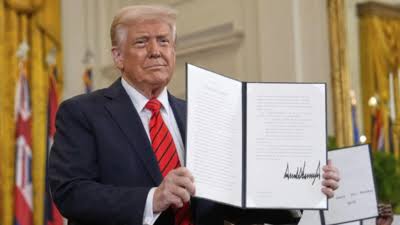
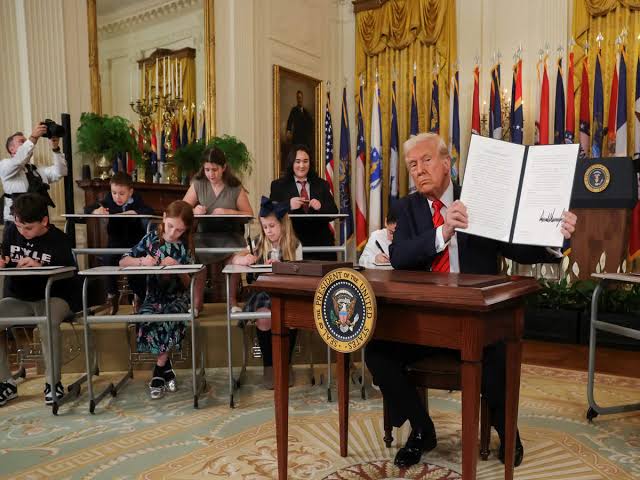
Former U.S. President Donald Trump has signed an executive order aimed at dismantling the Department of Education, a move that has sparked intense debate across the country. The signing ceremony, held in the East Room of the White House, saw Trump surrounded by schoolchildren as he proudly displayed the signed order, declaring his commitment to returning education control to individual states.

While the executive order does not immediately eliminate the department—such a move would require Congressional approval—it does set the stage for significant cutbacks. The administration has already initiated deep budget cuts and staff reductions, with nearly half of the department’s workforce reportedly laid off. The move has been endorsed by influential conservatives, including tech billionaire Elon Musk, whose “Department for Government Efficiency” (DOGE) has been advising the administration on downsizing federal agencies.
Supporters of Trump’s decision argue that education policy should be handled at the state level, pointing to nations like Finland and Norway, where decentralized education systems have seen success. Critics, however, warn that this shift could disproportionately harm low-income students, students with disabilities, and those in rural districts who rely on federal funding. Programs such as Title I and the Individuals with Disabilities Education Act, which ensure financial support for underprivileged students, could face severe cuts or even elimination.
The executive order has also triggered legal challenges, with multiple lawsuits filed by civil rights groups and Democratic lawmakers. While Trump insists that essential functions such as Pell Grants and student loan services will remain intact, opponents fear that without federal oversight, education disparities could widen.
Public opinion on the move is divided. A Reuters/Ipsos poll found that 65% of Americans oppose dismantling the department, with only 30% in favor. Many educators argue that while reforms may be needed, an outright dismantling of the Department of Education could create chaos in an already struggling system.
With legal battles looming and Congress likely to push back, the future of Trump’s executive order remains uncertain. Whether this marks a fundamental shift in U.S. education policy or a political maneuver that ultimately stalls in legislative and judicial proceedings is yet to be seen.