
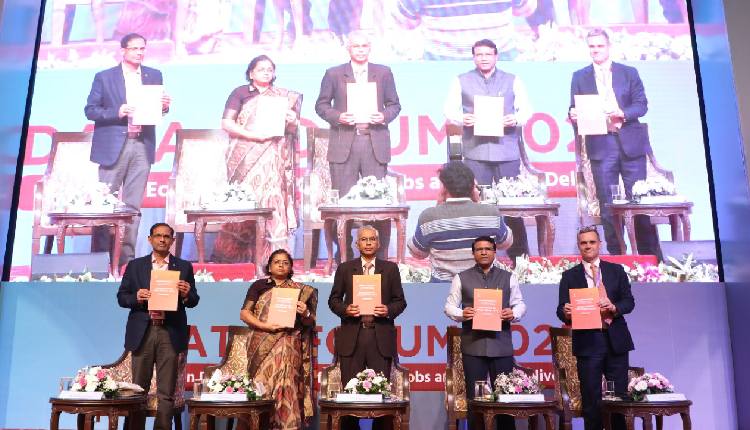
Lead: NITI Aayog’s State Support Mission (SSM) hosted the third NITI-State Workshop on “Urban Data Ecosystems for Growth, Jobs and Service Delivery” in Bhopal on 20–21 November, during which the City Data and Analytics Platform (CDAP) — a micro-site of the National Data and Analytics Platform (NDAP) — was launched to strengthen evidence-based urban governance across states and cities.
Why urban data ecosystems matter
Well-designed urban data ecosystems let cities collect, integrate and use data for planning, investment and service delivery. The Bhopal forum emphasised that reliable city-level data helps policymakers prioritise infrastructure, design job-creation strategies and improve public services. By building interoperable systems, states can make faster, evidence-driven decisions that align with national goals like Viksit Bharat@2047.
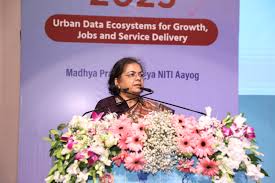

More than 100 participants from central ministries, state governments, the World Bank, academia and civil society attended the two-day workshop. Notable attendees included Shri Anurag Jain, Chief Secretary of Madhya Pradesh; Shri Srikanth Viswanathan, CEO of Janaagraha; and Shri Sanjay Kumar Shukla, Additional Chief Secretary, Madhya Pradesh. NITI Aayog’s Ms Anna Roy outlined the Data Forum’s purpose and noted this was the third edition aimed at institutionalising state engagement on urban data governance.
Launch of CDAP — what it offers
Organisers launched the City Data and Analytics Platform (CDAP), a dedicated NDAP microsite that provides cities and states with an accessible interface to high-quality urban datasets, visualization tools and analytics. CDAP is intended as a single-window resource for planners, researchers and city administrators to track indicators on employment, infrastructure, health, mobility and municipal finance.
Four themes that shaped the forum
The Data Forum structured discussions around four themes: (1) building strong data foundations through governance, standards and institutional frameworks; (2) positioning cities as engines of growth and job creation using economic and spatial data; (3) improving service delivery and participatory planning; and (4) applying frontier technologies such as AI and ML for real-time operations and monitoring.
State best practices and global inputs
Delegates shared state-level best practices for urban data platforms, GIS integration and local statistical systems. World Bank experts showcased international approaches to business registers and sub-national growth estimation, while central officials highlighted national programmes like PM Gati Shakti and ULIP that supply valuable GIS layers and integrated datasets for planning.
Practical outcomes and next steps
Participants recommended strengthening institutional capacity within municipal bodies, adopting interoperable data standards and setting up city-level data cells that can feed into CDAP. States were urged to pilot CDAP integrations with existing municipal management systems, and to prioritise datasets that unlock investment and job-creation potential.
What this means for cities
For city administrators and urban planners, a functioning urban data ecosystem means faster diagnosis of problems — from sewer coverage gaps to skills shortages — and evidence-backed policy choices. For citizens, better data can deliver improved services, more transparent planning and opportunities for local economic growth.
Links and references
Readers interested in the forum details and CDAP can consult NITI Aayog resources and the Press Information Bureau release for official documentation and follow-up materials.