
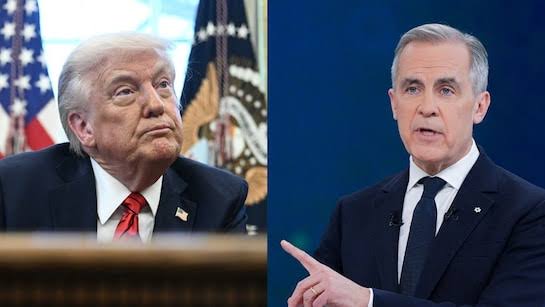
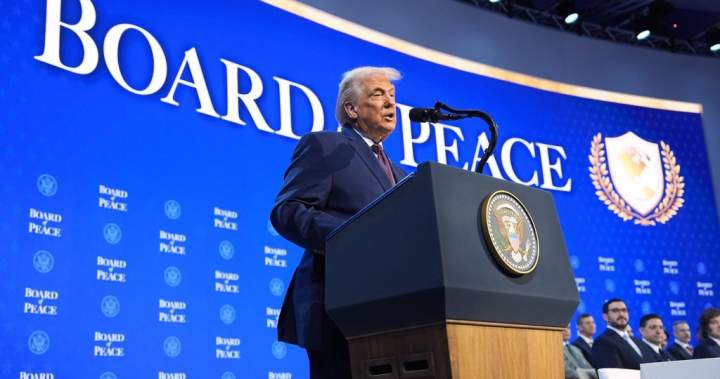
Diplomatic tensions between the United States and Canada escalated sharply this week after US President Donald Trump withdrew an invitation for Canada to join his self-styled “Board of Peace,” following a public war of words with Canadian Prime Minister Mark Carney.

Speaking at Davos earlier this week, Prime Minister Carney suggested that countries like Canada could no longer rely on unquestioned US leadership to guarantee global stability. His remarks were widely interpreted as a critique of Trump’s foreign policy approach, though the US president was not mentioned by name.
Trump responded forcefully the following day, claiming during a public address that “Canada lives because of the United States,” a remark that sparked political backlash north of the border.
Addressing the nation from Quebec City on Thursday, Carney rejected the assertion outright. “Canada doesn’t live because of the United States. Canada thrives because we are Canadian,” he said, while acknowledging the long-standing partnership between the two countries.
Invitation Withdrawn on Social Media
Hours after Carney’s address, Trump took to his Truth Social platform to announce that Canada’s invitation to join the “Board of Peace” had been withdrawn. The board, promoted by Trump as a billion-dollar initiative to resolve global conflicts, has drawn skepticism from diplomatic circles.
A Canadian government source later confirmed that Ottawa had no intention of paying to join the body, despite earlier indications that Carney would consider participation.
Trade Dependence Complicates Ties
The dispute highlights deeper structural tensions between the two allies. Canada remains heavily dependent on trade with the United States, which accounts for over three-quarters of its exports. Key sectors such as automobiles, aluminum, and steel have already felt the impact of Trump’s sector-specific tariffs.
While the effects have been partly cushioned by an existing North American free trade framework, negotiations to revise the agreement are scheduled to begin later this year. Trump has repeatedly claimed the US does not need Canadian imports, a position that could have severe economic consequences for Canada.
Rhetoric Raises Sovereignty Concerns
Adding to the strain, Trump has previously floated controversial ideas about annexing Canada and recently shared an image online depicting Canada, Greenland, and Venezuela under the American flag. Canadian officials have dismissed such rhetoric but acknowledge the seriousness of the current geopolitical climate.
“The world is more divided,” Carney said, warning that traditional alliances are being “redefined and, in some cases, broken.” He emphasized the need for Canada to increase defense spending and secure its borders.
Canada Positions Itself as Democratic Model
In his national address, Carney framed Canada as a potential example in an era of democratic decline. He argued that while Canada cannot solve every global problem, it can demonstrate that inclusive governance and rule-based systems remain viable.
Analysts note that the standoff reflects broader uncertainty in global diplomacy, particularly as countries reassess their reliance on traditional power structures. India, which has also advocated strategic autonomy in foreign policy, has closely followed such shifts through forums like the G20 and BRICS.