

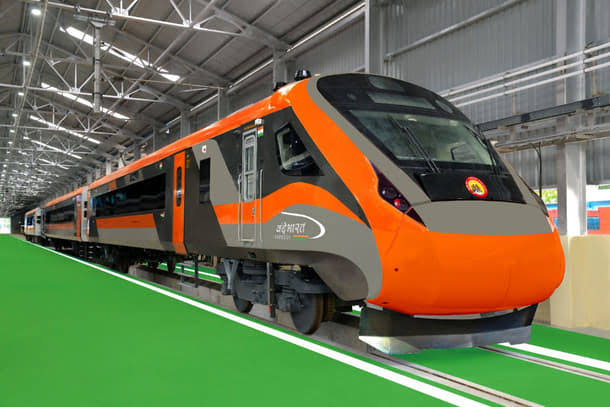

Vande Bharat Express represents a significant shift from conventional locomotive-hauled trains to self-propelled, integrated trainsets designed for efficiency and reliability. Developed indigenously, the trainsets are optimised for medium-distance inter-city routes where faster travel and superior passenger experience are increasingly in demand.
The introduction of Vande Bharat builds on the legacy of earlier premium services such as the Rajdhani and Shatabdi Express trains. However, it aligns more closely with present and future mobility requirements by combining advanced safety systems, modern design, and reduced journey times.
Advanced Features and Passenger Comfort
Vande Bharat trains are equipped with semi-permanent jerk-free couplers, improved suspension systems, and regenerative braking, contributing to smoother rides and enhanced energy efficiency. The trains also feature centrally controlled automatic plug doors, wider gangways, and modern air-conditioning systems.
Safety remains a core focus, with the integration of the indigenously developed Train Collision Avoidance System, KAVACH, certified to the highest safety integrity standards. CCTV cameras, emergency alarms, passenger–crew communication systems, and coach condition monitoring further strengthen onboard security.
Seven Years of Rapid Expansion
Launched on 15 February 2019 on the New Delhi–Varanasi corridor, the Vande Bharat Express began as a 16-coach fully air-conditioned service designed for speeds of up to 160 kmph. Since then, services have expanded rapidly across the national rail network.
By December 2025, Vande Bharat trains were operational in 274 districts and had carried more than 7.5 crore passengers. Faster acceleration and deceleration have enabled journey time reductions of up to 45 percent on several routes, significantly enhancing inter-city connectivity.
High Demand and Occupancy
Passenger response to Vande Bharat services has been overwhelmingly positive. Occupancy levels stood at over 102 percent in 2024–25 and rose further to more than 105 percent in 2025–26 up to June 2025.
This sustained demand highlights a structural shift in passenger preferences towards faster, cleaner, and more reliable rail travel, extending beyond metropolitan corridors into regional routes.
Next-Generation Vande Bharat Platforms
The evolution of Vande Bharat continues with upgraded versions aimed at improving performance and efficiency. Vande Bharat 2.0, introduced in 2022, features lighter trainsets, improved energy efficiency, and enhanced safety systems.
Subsequent versions, including Vande Bharat 3.0 and the upcoming 4.0, are designed to deliver faster acceleration, superior ride quality, and next-generation safety technology, positioning India’s rail systems closer to global benchmarks.
Vande Bharat Sleeper: Expanding Long-Distance Travel
Further expanding the platform, Indian Railways is set to introduce the Vande Bharat Sleeper Train in January 2026. The first service will operate on the Howrah–Guwahati corridor, strengthening connectivity between eastern and northeastern India.
The sleeper variant is designed for overnight journeys, offering faster travel times, improved comfort, and modern onboard amenities. Trial runs and safety certifications have already been completed successfully.
Vision for the Future
Vande Bharat Express is envisioned as a cornerstone of India’s passenger rail modernisation. The government aims to scale the fleet to around 800 trainsets by 2030 and nearly 4,500 by 2047, subject to infrastructure readiness.
With its emphasis on indigenous manufacturing, energy efficiency, and passenger-centric design, Vande Bharat underscores the role of railways in driving sustainable and inclusive national development.