

Shri Radhakrishnan observed that IIHT Salem plays a crucial role in bridging indigenous craftsmanship with contemporary textile technology. By integrating traditional knowledge with scientific advancements, the institute has enhanced productivity, improved quality standards, and promoted market-driven production, while maintaining the authenticity of handwoven textiles.
Highlighting India’s rich handloom legacy, the Vice-President referenced globally recognized products, including Varanasi silk brocades, Bengal’s Jamdani, Assam’s Muga silk, Kashmir’s Kani shawls, Andhra Pradesh’s Venkatagiri and Mangalagiri weaves, and Madhya Pradesh’s Maheshwari and Chanderi sarees. He also drew attention to Tamil Nadu’s vibrant weaving traditions such as Chettinadu Kandangi, Kanchipuram, Arani, Thirubuvanam, Chennimalai, and Madurai Sungudi textiles.
Salem and Tamil Nadu: Centres of Weaving Excellence
The Vice-President recognized key weaving hubs across Tamil Nadu, including Salem, Erode, Bhavani, Chennimalai, Madurai, Sathyamangalam, Karur, Sankarankovil, Andipatti, Ettayapuram, Paramakudi, Sayarpuram, Puliyampatti, and Srivilliputhur. These centres continue to uphold traditional weaving skills while contributing to the state’s economic growth and cultural preservation.
Shri Radhakrishnan also reflected on Salem’s historical connection to the distinguished national leader Thiru C. Rajagopalachari, who began his legal career in the city and served as Member and Chairman of the Salem Municipality.
Future-Ready Handloom Industry and Global Competitiveness
Addressing trade prospects, the Vice-President noted that the recent India–EU Free Trade Agreement will enhance the global competitiveness of India’s textile sector, benefiting exports from Salem and beyond. Leather exports from Ambur are also expected to see significant growth under these initiatives.
Shri Radhakrishnan called for transforming the handloom sector into a future-ready creative industry that generates sustainable livelihoods, preserves artisan dignity, and produces value-added products aligned with global markets. He expressed confidence that such efforts would strengthen both domestic and international recognition of Indian handlooms.
Exhibition Showcasing Handloom Excellence
The Vice-President also visited an exhibition at IIHT Salem, where handloom products from across the country were displayed. The exhibition demonstrated the diversity, skill, and cultural heritage of India’s artisans, highlighting the potential for innovation and market expansion within the sector.
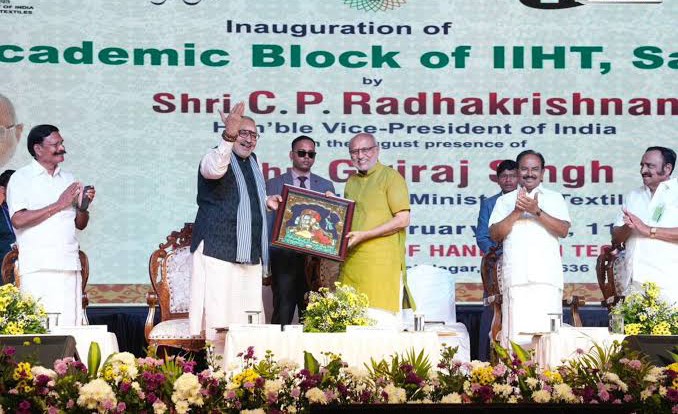
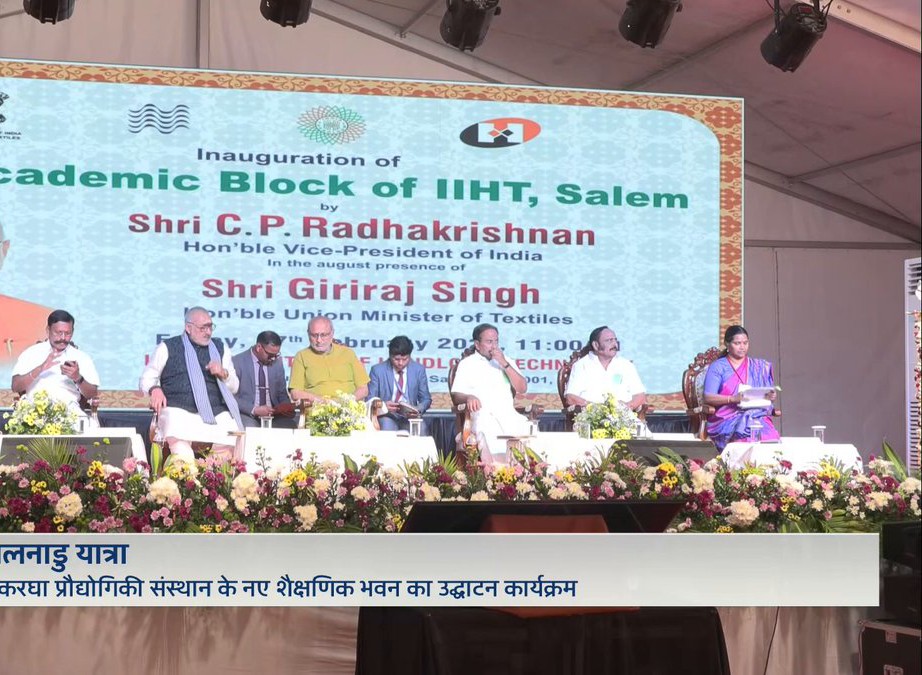
The event was attended by Union Minister of Textiles Shri Giriraj Singh, Tamil Nadu Minister for Tourism Shri R. Rajendran, and other dignitaries, reinforcing the collaborative efforts between government, institutions, and artisans in promoting India’s handloom heritage.