
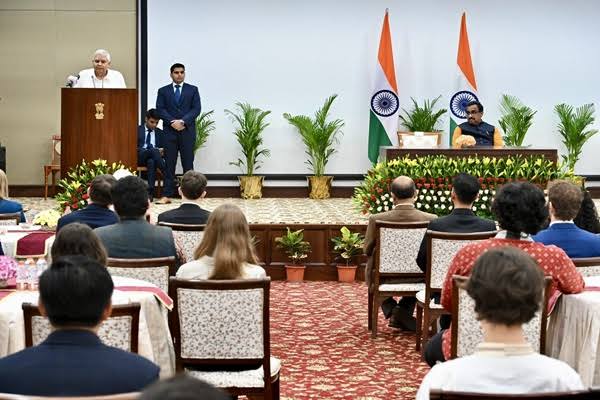
On May 8, 2025, Vice President Shri Jagdeep Dhankhar expressed admiration for the leadership style of Prime Minister Narendra Modi, highlighting how his approach exemplifies the timeless wisdom of Kautilya’s philosophy. Speaking during an interaction with the Kautilya Fellows from the India Foundation in New Delhi, the Vice President reflected on the profound relevance of Kautilya’s teachings in contemporary governance. According to Dhankhar, Kautilya’s principles serve as a comprehensive guide to statecraft, governance, and the role of the ruler in ensuring the welfare of the people.
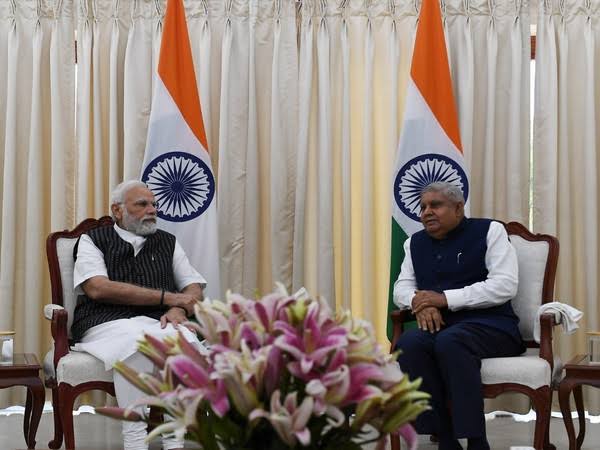

Shri Dhankhar went on to emphasize the Prime Minister’s visionary leadership, noting how Modi’s focus on large-scale transformation has had a significant impact on the nation. The Vice President particularly lauded the Prime Minister’s ability to drive change on a massive scale, citing his long tenure in office, which is a rare occurrence in India’s political history. “It is after decades that we have a Prime Minister continually in the third term, and that is making all the difference,” he remarked.
The Vice President also reflected on Kautilya’s philosophy that emphasizes participatory democracy and the collective contribution of individuals to national welfare. He cited Kautilya’s belief that a nation’s progress depends on the discipline and decorum of its people. “Just as one wheel alone does not move a cart, administration cannot be accomplished single-handedly,” Dhankhar quoted, illustrating how governance requires collaboration at every level.
Dhankhar pointed out how these ancient teachings are echoed in Modi’s governance approach, particularly his efforts to uplift the country’s neglected regions. He mentioned the transformation of “Aspirational Districts,” areas that were previously underserved but have now become leaders in development. The creation of “smart cities” also aligns with Kautilya’s idea of a participatory and inclusive nation, where economic activity is encouraged not just in metropolitan hubs but in Tier 2 and Tier 3 cities as well.
In reflecting on the essence of governance, the Vice President quoted Kautilya’s Arthashastra, stating, “The happiness of the king lies in the happiness of his people.” This, he noted, forms the cornerstone of any democratic system, underlining that the ultimate goal of governance should always be the welfare of its citizens.
Concluding his address, Dhankhar emphasized that democracy in India is not a product of the Constitution alone but has been rooted in the country’s ancient civilizational ethos. He pointed to the Vedic concept of Anant Vaad, which represents the continuous and open dialogue that is central to the democratic spirit. “Democracy is nurtured best when expression and dialogue complement each other,” he said, underscoring that India’s democratic values have been an integral part of its culture for thousands of years, long before the formal establishment of the Constitution or independence.
This interaction underscored the deep connection between ancient philosophical principles and modern governance, reinforcing the idea that the happiness and welfare of the people must remain at the heart of any leader’s vision for the nation.