
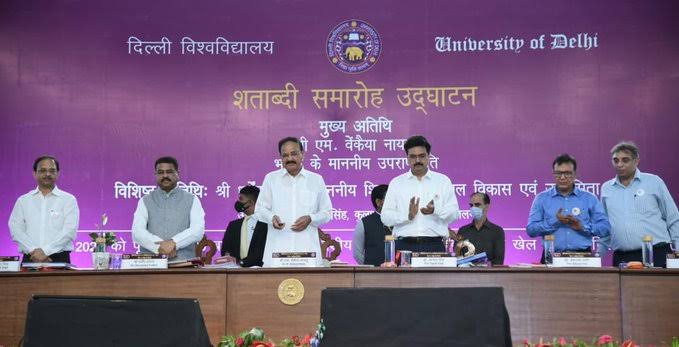
At the inauguration of ‘KARTAVYAM’ at Delhi University, the Vice President of India delivered a heartfelt and stirring address that resonated deeply with the students, faculty, and all attendees. His words were not merely a speech but a powerful call to action—a reminder of the responsibilities that come with the privileges of democracy and education.

He paid tribute to Justice H.R. Khanna, an alumnus of Delhi University, whose lone dissent during the Emergency became a beacon of hope for those fighting for democratic integrity. Recalling the dark days of June 1975, when fundamental rights were suspended and dissent was crushed, he underscored the courage it took for one man to stand for truth. “If India ever finds its way back to the freedom and democracy that were proud hallmarks of its first eighteen years as an independent nation,” he quoted from a New York Times editorial, “someone will surely erect a monument to Justice H.R. Khanna.”
Through his passionate narrative, the Vice President emphasized the significance of observing both Constitution Day and what he termed ‘Samvidhaan Hatya Diwas’—not to mourn, but to remember the cost of complacency and the price of silence. He urged the students to reflect not just on their rights, but more so on their duties. The Constitution, he said, is not a static document; it evolves with the aspirations of its people. It is a living testament to India’s civilizational ethos and democratic spirit.
He spoke of the critical role youth play in shaping the discourse of democracy. In a world increasingly influenced by media manipulation and foreign interests, he appealed to the students to rise above partisanship and embrace thoughtful deliberation. “You are not mere spectators,” he reminded them, “you are the soul of democracy.” This soul, he said, is only truly awakened when it performs its duty—engaging in dialogue, upholding justice, and protecting the constitutional values that define the nation.
He further highlighted the importance of self-reliance, national pride, and moral integrity. Recalling Gandhian ideals and Vedic teachings, he invoked a vision of India rooted in collective responsibility and civic consciousness. He outlined five pillars for national transformation: social harmony, unity in diversity, family-based patriotism, economic nationalism, and civic duties. These, he said, must be the foundation upon which the youth build the India of tomorrow.
His address, rich in philosophical depth and democratic fervor, did not shy away from critiquing superficial idolization or hollow symbolism. Instead, he encouraged introspection and action. Every citizen, he asserted, carries atomic power—the power to influence change, to uphold truth, and to protect the integrity of the republic.
In closing, the Vice President reminded the students that democracy is not sustained by law alone but by culture, character, and community. “Democracy thrives through abhivyakti (expression) and samvaad (dialogue),” he said, urging the next generation not to merely inherit the legacy of freedom but to actively preserve and enrich it. Through ‘KARTAVYAM’—a Sanskrit word meaning ‘duty’—he hoped a renewed spirit of accountability and constitutional awareness would emerge from the very heart of the nation’s youth.
His words echoed long after the event ended, leaving behind not just inspiration, but a sense of shared responsibility and hope for a stronger, more enlightened India.