 Minister Highlights Collective National Water Effort
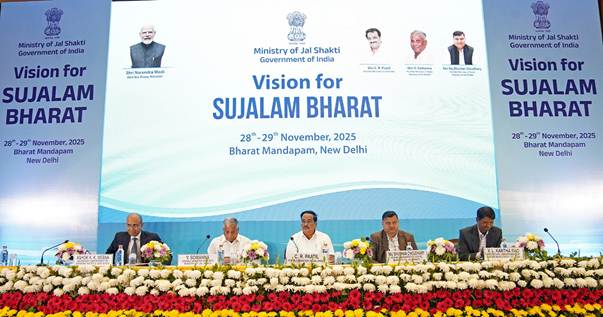
Union Minister of Jal Shakti, Shri C.R. Paatil, emphasised that Sujalam Bharat is a national initiative aligning with Prime Minister Narendra Modi’s vision. The summit focuses on integrating scientific approaches, sustainable practices, and community participation to ensure long-term water security.
Highlighting India’s water challenge, Minister Paatil noted that the country has 18% of the world population but only 4% of freshwater resources. He urged active community participation and emphasized that sustainable water-conservation structures are critical to meeting national needs.
Major Initiatives and Launches
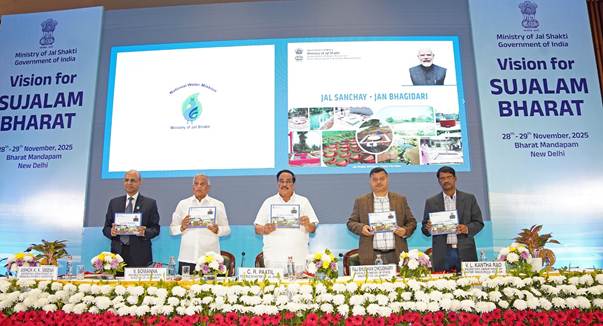
During the inauguration, Minister Paatil released the Book on Jal Sanchay Jan Bhagidari 1.0, showcasing successful community-led groundwater recharge efforts. He also launched the Ganga Pulse Public Portal, providing real-time river health information, and presented a report on the ecological status of the Barak River Basin.
The summit highlighted major ongoing initiatives, including the Jal Shakti Abhiyan (JSA), Jal Jeevan Mission (JJM), Swachh Bharat Mission (SBM), and the Modernization of Command Area Development and Water Management (SAMRIDHI-MCAD). These programs aim to improve water access, irrigation efficiency, and river health restoration across India.
Community Engagement and Social Impact
Minister of State Shri V. Somanna described Sujalam Bharat as a collective national endeavour to build water-secure, healthy, and empowered communities. Minister of State Shri Raj Bhushan Choudhary stressed that water security impacts health, hygiene, livelihoods, and social dignity, particularly empowering women.
The summit emphasised that access to clean water facilitates education, diversified agriculture, nutrition, and improved quality of life. Community participation, traditional knowledge, and modern technology are central to transforming India’s water systems.
Thematic Focus Areas
The summit is structured around six core themes:
- Rejuvenation of Rivers and Springs continuous and clean flows, catchment management, wetland restoration, and river stewardship.
- Sustainability of Drinking Water – safe drinking water, source planning, climate-resilient infrastructure, and digital governance.
- Technology for Efficient Water Management – AI-based monitoring, micro-irrigation, leak detection, and precision agriculture.
- Water Conservation and Recharge – managed aquifer recharge, revival of traditional systems, and LiFE-aligned behavioral interventions.
- Greywater Management and Reuse – circular water use, nature-based solutions, and industrial/urban applications.
- Community & Institutional Engagement – strengthening institutions, frontline workers, and inter-departmental convergence for sustainability.
Feedback from participants will be consolidated into actionable recommendations to guide implementation across departments and partner institutions, ensuring India’s path toward a water-secure and climate-resilient future.