
Call for Transparent Judiciary in Democracy
Vice-President Jagdeep Dhankhar has stirred a crucial debate on the integrity and accountability of India’s judiciary. Speaking at the National University of Advanced Legal Studies (NUALS), he questioned the lack of immediate legal action after a massive cash haul from a High Court judge’s official residence.
“We must find out whose money it is. How did it land in a judge’s residence?” he asked. He emphasized that while using the constitutional mechanism is valid, it is not a full solution. The bigger question is accountability within the system.
Unshakable Faith at Risk
“The citadel of trust is tottering,” Dhankhar warned. He said that if people’s faith in the judiciary erodes, India as a democracy will face serious consequences.
Referring to the night of March 14–15 as the “Ides of March” for the judiciary, he noted that the discovery of unaccounted cash should have triggered an FIR. However, due to a Supreme Court ruling from the 1990s, even central agencies are reportedly unable to act.


Highlighting another critical concern, the VP questioned the practice of offering post-retirement posts to judges. “Pick-and-choose appointments create space for patronage,” he said. He compared this to other constitutional offices like CAG and Election Commissioners who are barred from post-retirement government jobs to avoid undue influence.
Oath to Defend the Constitution
Dhankhar pointed out a constitutional nuance — only the President and Governors take an oath to “preserve, protect, and defend” the Constitution. All other public functionaries, including the Prime Minister and judges, merely swear to abide by it. This, he said, makes the roles of the President and Governor uniquely responsible.
Emergency Era and the Preamble Debate
The Vice-President touched upon the controversial 42nd Constitutional Amendment during the Emergency period. He compared changes to the Preamble to altering parenthood — “It’s not possible,” he said. He reminded the audience that the amendment was passed when thousands were in jail and basic rights were suspended.
“Can a democracy be functional without access to justice?” he asked, referencing the ADM Jabalpur case where the Supreme Court failed to protect civil liberties.
Need for Separation of Powers
Dhankhar emphasized the importance of the doctrine of separation of powers. Each branch — the executive, legislature, and judiciary — must stay within its defined role. “If one crosses the line, it disrupts the entire democratic balance,” he noted.
He criticized the current practice of including the Chief Justice in executive appointments like that of the CBI Director. “Why should the judiciary have a say in appointing an executive functionary?” he asked. According to him, this blurs the constitutional boundaries.


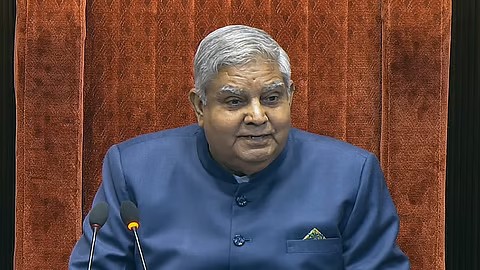
Caption: VP Dhankhar engages law students in a powerful dialogue on democracy, law, and ethics.
Youth Must Question and Lead
Addressing students directly, the VP urged them to have the courage to question power. “You must be architects of a just and peaceful world,” he said. He praised the current Chief Justice and his predecessor for restoring transparency and getting the judiciary back on track after a “very disturbing” two-year period.
Conclusion: A Wake-up Call for Democratic India
Vice-President Dhankhar’s speech serves as a wake-up call. It challenges complacency, urges constitutional clarity, and demands accountability — especially from those entrusted with justice. A democracy cannot afford blind faith; it needs courageous introspection.