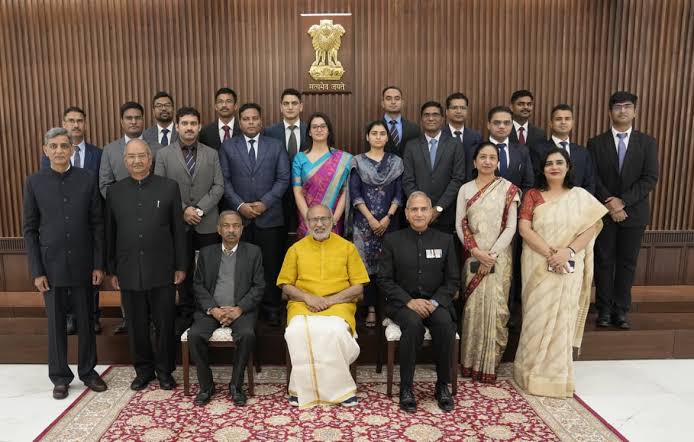
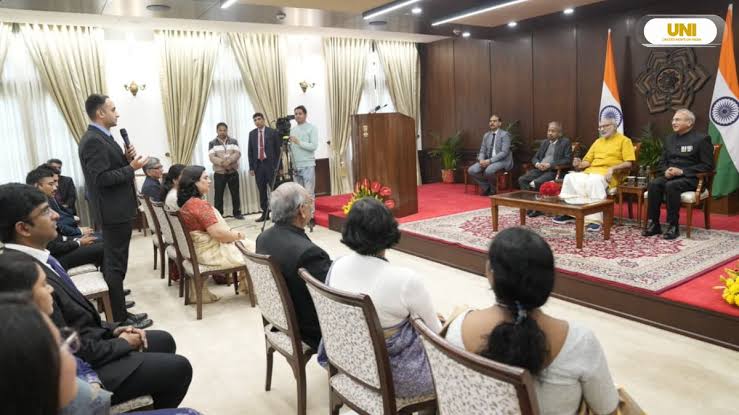
Addressing the officers, the Vice-President highlighted that public service is not merely about authority or administration, but about serving people with empathy and integrity. He stressed that patience and attentive listening are essential qualities for humane governance, adding that many public grievances can be resolved simply by giving citizens a patient hearing.
 Patience and Listening at the Core of Governance
Drawing attention to the changing nature of public discourse, Shri Radhakrishnan observed that while loud voices often dominate social media and public platforms today, such popularity is usually short-lived. In contrast, meaningful debate and calm engagement build lasting public trust.
He recalled the legacy of respected parliamentarians such as Shri Atal Bihari Vajpayee, Shri N. G. Ranga and Shri N. G. Gore, noting that their enduring influence stemmed from the quality and substance of their debates rather than volume or rhetoric. According to the Vice-President, patience and thoughtful dialogue remain timeless virtues in democratic governance.
Sardar Patel’s Legacy and Nation Building
Remembering Sardar Vallabhbhai Patel, the “Iron Man of India,” the Vice-President described the integration of princely states as an unmatched achievement in global history. He pointed out that while Otto von Bismarck unified Germany where people largely shared a common language, Sardar Patel unified a nation marked by immense linguistic, cultural and social diversity.
He also highlighted Sardar Patel’s pivotal role in the establishment of the All India Services, which continue to serve as a backbone of India’s administrative system. The Vice-President said this historic contribution remains a guiding light for civil servants tasked with preserving unity while respecting diversity.
Role of UPSC and Training Institutions
The Vice-President appreciated the Union Public Service Commission (UPSC) for its rigorous and impartial process of selecting capable officers. He also commended training institutions such as HIPA for equipping young officers with the necessary orientation, values and skills required for public service.
As India moves towards the vision of Viksit Bharat @2047, he urged the officers to perform their duties in the spirit of the Bhagavad Gita. Emphasising the principles of karma and dharma, he advised them to focus on sincere action without being driven by personal gain, and to always uphold righteousness in decision-making.
Accountability, Technology and Timely Decisions
Highlighting the importance of accountability, Shri Radhakrishnan called for the timely disposal of files and cases, noting that delays often erode public confidence. He encouraged officers to make effective use of technology to enhance efficiency, transparency and service delivery.
The Vice-President said that responsible use of digital tools can significantly improve governance outcomes, provided it is backed by integrity and a service-oriented mindset.
Social Media, Misinformation and Responsible Conduct
Responding to queries from the officer trainees, the Vice-President addressed the challenges posed by information overload, misinformation and the spread of negative news on social media. He cautioned that unverified or sensational content can harm institutions and individuals alike.
He advised officers to promote positive and constructive narratives and to exercise social responsibility before sharing any content online. Stressing the need for appropriate action to encourage responsible digital behaviour, he reminded the trainees that civil servants are role models whose conduct, both online and offline, carries significant influence.
Message to Young Officers
Concluding the interaction, the Vice-President emphasised the importance of continuous learning, adherence to ethical values and patience throughout one’s career. He encouraged the young officers to remain grounded, listen to the people they serve and approach challenges with humility and resolve.
The interaction left the officer trainees with valuable perspectives on leadership, ethical governance and the deeper purpose of public service, reinforcing the idea that true nation building begins with character, compassion and commitment.