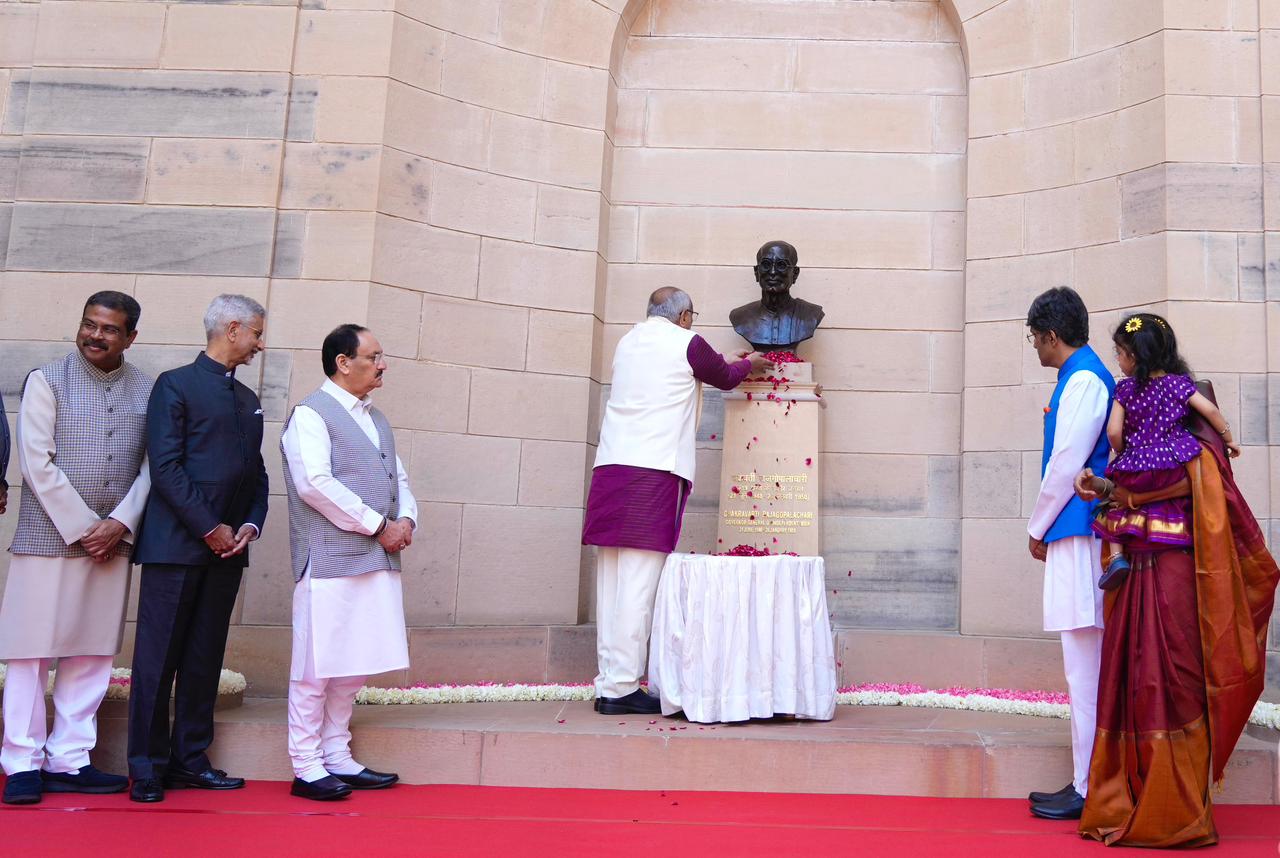
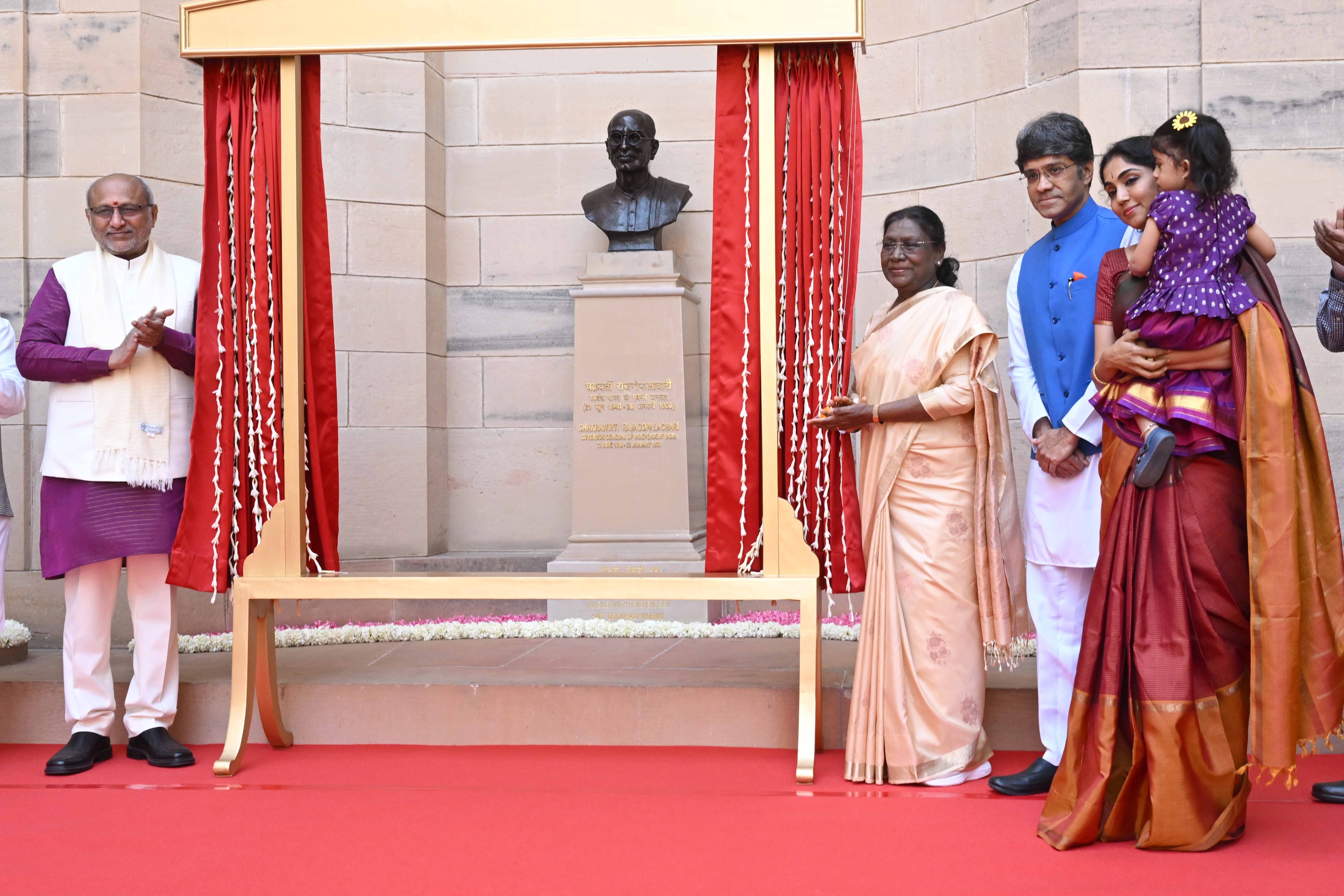
New Delhi, February 23, 2026: Vice President C.P. Radhakrishnan on Sunday said the unveiling of Chakravarti Rajagopalachari’s bust at Rashtrapati Bhavan marks a decisive step in shedding the remnants of colonial influence and strengthening India’s civilisational confidence.
The ceremony was attended by President Droupadi Murmu, who unveiled the bust, along with Union Ministers and dignitaries. The event forms part of broader initiatives aimed at reasserting India’s cultural identity.
 An Ongoing National Transformation
The Vice President stressed that India’s movement away from colonial influence is not a single act but an ongoing transformation. He said reforms across governance, law, education, and culture reflect a deeper effort to reshape national consciousness.
He credited Prime Minister Narendra Modi’s vision of “Gulami ki Mansikta se Mukti” for guiding these reforms. According to him, the aim is to remove colonial-era imprints from institutions and attitudes that persisted after Independence.
“These changes are not merely symbolic; they reflect the Government’s spirit of Sewa Bhavna,” he said, underlining that service to the nation remains central to the reform process.
Concrete Steps Toward Change
Highlighting key initiatives, the Vice President cited the transformation of Raj Bhavans into more people-centric Lok Bhavans and the evolution of the Prime Minister’s Office into what he described as a ‘Sewa Teerth’. He also referred to the renaming of the Central Secretariat as Kartavya Bhavan.
He pointed to the replacement of colonial-era criminal laws as another significant milestone. The installation of Netaji Subhas Chandra Bose’s statue near India Gate and the construction of the National War Memorial were also mentioned as symbols of national pride.
According to him, these measures collectively signify India’s determination to honour its own heroes and values rather than continue colonial-era traditions.
Reforms at Rashtrapati Bhavan
The Vice President also praised several initiatives undertaken at Rashtrapati Bhavan under President Murmu’s leadership. The Mughal Gardens have been renamed Amrit Udyan, while Durbar Hall has been rechristened Ganatantra Mandap.
Photographs of British Aides-de-Camp that once adorned the corridors have been replaced with portraits of Param Vir Chakra awardees. Additionally, ‘Granth Kutir’ has been inaugurated as a repository of classical Indian languages and manuscripts.
He observed that such efforts are helping to erase colonial imprints from public spaces while strengthening India’s civilisational identity.
Rajaji: A Multifaceted Leader
Describing Rajaji Utsav as a rightful recognition of a great son of India, the Vice President said Chakravarti Rajagopalachari holds a distinguished place in Indian history. Rajaji was the first and only Indian Governor-General of independent India.
He highlighted Rajaji’s brilliance as a lawyer, freedom fighter, administrator, writer, and statesman. His intellectual depth and moral clarity, he said, continue to inspire generations.
The Vice President noted that Rajaji strongly advocated economic freedom and believed India’s economic policies should remain independent and liberal. His emphasis on principled governance and character-building remains relevant in contemporary India.
Inspiration for Future Generations
Concluding his address, the Vice President expressed hope that Rajaji’s life would inspire citizens to elevate their character as they take on greater responsibilities. He urged people to strengthen their convictions as their roles expand and to always place the nation above personal interest.
The Rajaji Utsav celebrations at Rashtrapati Bhavan also include exhibitions and cultural programmes highlighting Rajaji’s life and contributions. The exhibition is open to the public for a limited period.