
Welfare for All: A Holistic Approach to Minority Upliftment
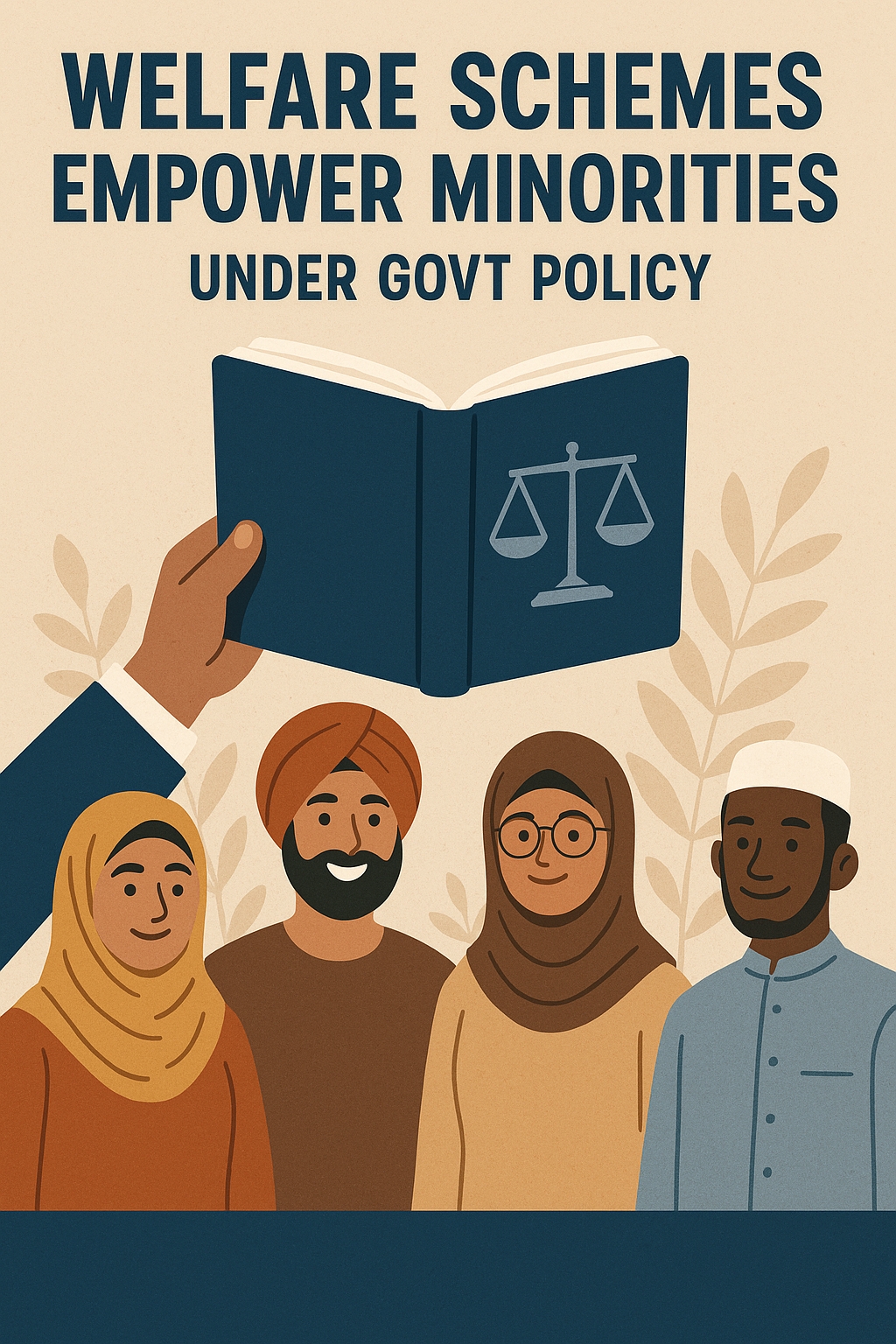
The government’s Sabka Saath Sabka Vikas policy drives inclusive development. It ensures welfare and empowerment for all, especially minority communities. The focus is on economically weaker groups from six centrally notified minorities: Muslim, Buddhist, Christian, Jain, Parsi, and Sikh.
These initiatives offer equal opportunities and welfare schemes to all eligible citizens. They are designed to be inclusive and universal, ensuring that no one gets left behind.
Constitutional Protection for Minorities
The Constitution of India guarantees strong protections for minorities. Articles 15(1) & (2), 16(1) & (2), and 25(1) safeguard equality and freedom for all. Articles 30(1), 30(1A), and 30(2) protect the cultural, linguistic, and religious rights of minorities.
These legal rights support government schemes and promote a fair, non-discriminatory society.


The government runs several welfare schemes for minority communities. These programs address their specific needs in areas like education, jobs, healthcare, and social security.
Many schemes have been updated to widen their reach and impact. These reforms align with the vision of Sabka Saath Sabka Vikas and aim to ensure that every section benefits from national progress.
Monitoring Mechanisms to Ensure Effective Delivery
To make sure schemes deliver results, the government has set up monitoring systems. One of the key agencies is the Development Monitoring and Evaluation Office (DMEO) under NITI Aayog.
DMEO tracks and evaluates scheme performance using the Output-Outcome Monitoring Framework (OOMF). This framework measures success using defined indicators. It also helps identify gaps and improve future planning.
Ministries and Departments Also Monitor Progress
Besides DMEO, various ministries have their own monitoring systems. These departments assess progress regularly and ensure benefits reach the right people.
This two-tier system of monitoring brings transparency and accountability. It helps ensure that implementation is efficient and effective.
Empowering Minority Communities: Achievements So Far
The government has achieved key milestones in uplifting minorities. Major accomplishments include:
- Better access to education through scholarships and skills training.
- More job opportunities with a push for entrepreneurship and self-employment.
- Improved healthcare through targeted initiatives.
- Expanded social security support and financial assistance.
These results show the government’s strong focus on equitable development and inclusion.
The Role of Monitoring in Achieving Results
Monitoring agencies like DMEO have played a major role in these successes. They identify weak areas and help modify schemes for better impact.
This regular assessment process keeps schemes relevant and responsive to public needs.
Future Vision: Ensuring Equitable Growth
The government’s future goal is clear — to build an inclusive India where every citizen thrives. Through Sabka Saath Sabka Vikas, the aim is to ensure fair growth across all communities.
Strengthening monitoring and improving delivery mechanisms will be key steps. These actions will help minority communities grow alongside the rest of the nation.
Conclusion
The government’s approach is changing lives, especially among minorities. By focusing on inclusion, transparency, and performance tracking, India is moving toward a society where everyone has an equal chance to succeed.