
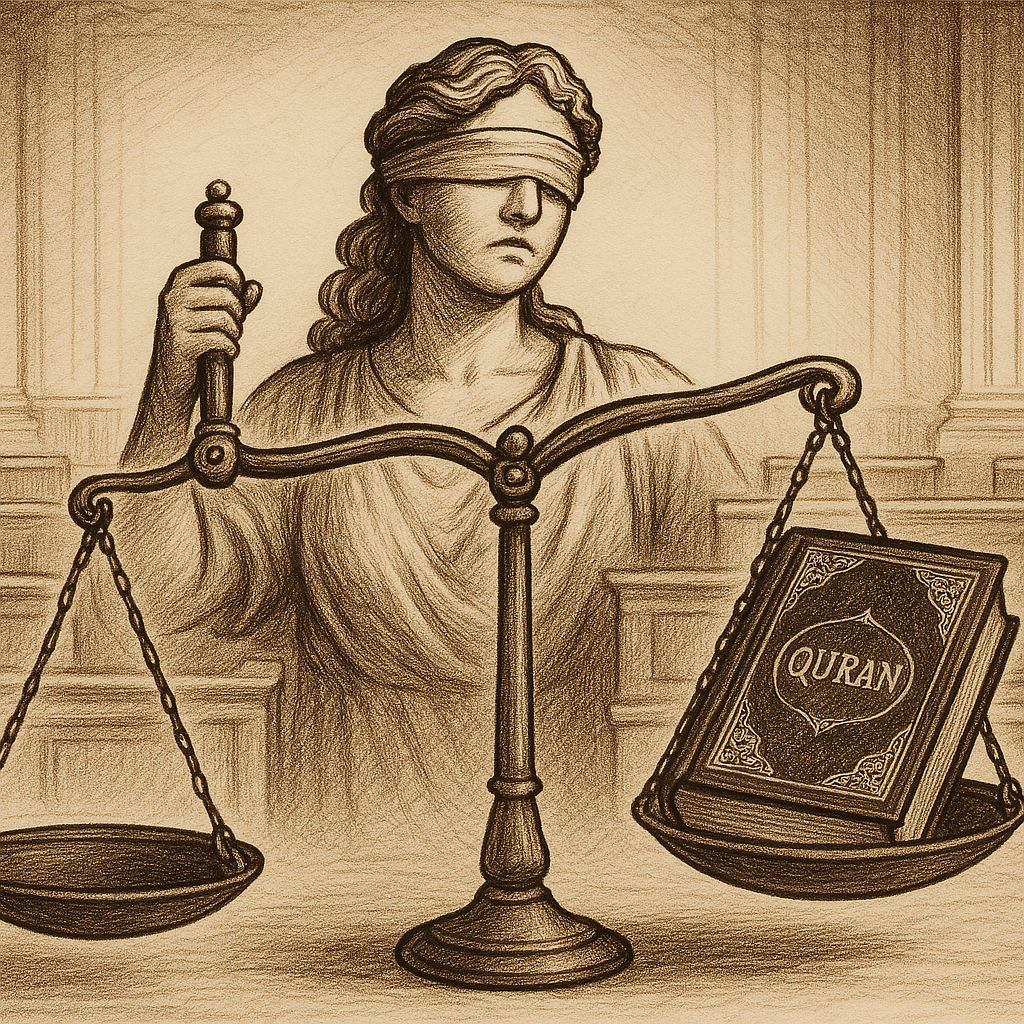
Yato Dharmastato Jayaḥ? (Where There Is Justice, There Is Victory)
India, as a secular democracy, guarantees freedom of religion and expression under its Constitution. Yet, these very freedoms have come under debate in legal cases that question whether religious texts should also be held accountable to modern standards of justice and human rights.
In a high-profile case some years ago, former Shia Waqf Board chairman Waseem Rizvi (now Jitendra Tyagi) filed a Public Interest Litigation (PIL) in the Supreme Court of India, seeking the removal of 26 verses from the Quran. Rizvi argued that these verses promoted violence and intolerance against non-Muslims and were inconsistent with a secular, democratic constitution. He cited concerns about youth radicalization and argued that a reinterpretation was essential for harmony.
However, the Supreme Court dismissed the PIL outright, labeling it as an attack on religious freedom. No investigation into the textual claims was permitted; no discussion on the substance of the verses was entertained. The court also fined Rizvi ₹50,000 for what it deemed a frivolous petition. The decision reflected judicial restraint, but it also raised a deeper question: Are all religious texts beyond any legal or moral scrutiny?
Saudi Arabia’s Reformist Moves
Ironically, while India’s apex court deemed it inappropriate to even discuss changes to the Quran, Saudi Arabia, often seen as the guardian of orthodox Islam, has itself been taking steps toward religious reform. Under Crown Prince Mohammed bin Salman’s Vision 2030 program, efforts are underway to reinterpret religious doctrines and curb the influence of extremist narratives. In 2021, Saudi officials openly questioned Hadiths that conflicted with modern values and began quietly revising textbooks to remove incendiary content.
In that light, the Indian court’s rigidity appears overly cautious. When even Islamic nations entertain the possibility of reinterpreting or contextualizing religious scripture, why should India’s courts refuse to even review such arguments?
The Forgotten “Calcutta Quran Petition”
Rizvi’s PIL wasn’t the first of its kind. In 1985, Chandmal Chopra, a businessman and activist, filed a similar petition in the Calcutta High Court. Chopra cited verses from the Quran that he claimed incited hatred and communal disharmony and sought a ban on its publication under Sections 153A and 295A of the Indian Penal Code—the same laws frequently used to ban books, movies, or speeches seen as offensive to religious groups.
This too was dismissed summarily, and the court refused to engage with the merit of the textual claims. The case was later documented in Sita Ram Goel’s book “The Calcutta Quran Petition”, which has since become a cult text in right-wing intellectual circles.
Double Standards in Legal Treatment?
Critics argue that the Indian state applies its secular laws unevenly. Numerous works of fiction or commentary—whether by M.F. Husain, Salman Rushdie, or Wendy Doniger—have been banned or attacked for allegedly hurting Hindu sentiments. On the other hand, religious sensitivities of minority communities, especially Muslims, are treated with greater caution, even when legitimate debate arises.
This perceived imbalance fuels discontent and raises difficult questions: Can a truly secular nation protect the sanctity of religious texts while ignoring their real-world consequences? Should freedom of religion include the freedom to critique religion—especially when certain verses or doctrines may contradict constitutional values?
Conclusion: The Cost of Silence
The Supreme Court may have aimed to avoid religious polarization, but by refusing to even discuss controversial verses, it arguably missed a chance to promote honest, reasoned debate about religion’s role in public life. Freedom of religion must coexist with freedom from religious coercion. Dismissing all such petitions out of hand only serves to deepen societal divides and fuels the perception of unequal justice.
If India is to remain a true secular republic, it must find the courage to examine all ideas—including religious ones—through the lens of justice, equality, and constitutional morality.
🧾 References:
-
Rizvi’s PIL: Supreme Court order, March 2021
-
“Calcutta Quran Petition” by Sita Ram Goel (Voice of India, 1987)
-
Saudi Arabia’s religious reforms: New York Times, “Saudi Arabia Signals the End of Ultra-Conservative Islam,” Dec 2021