
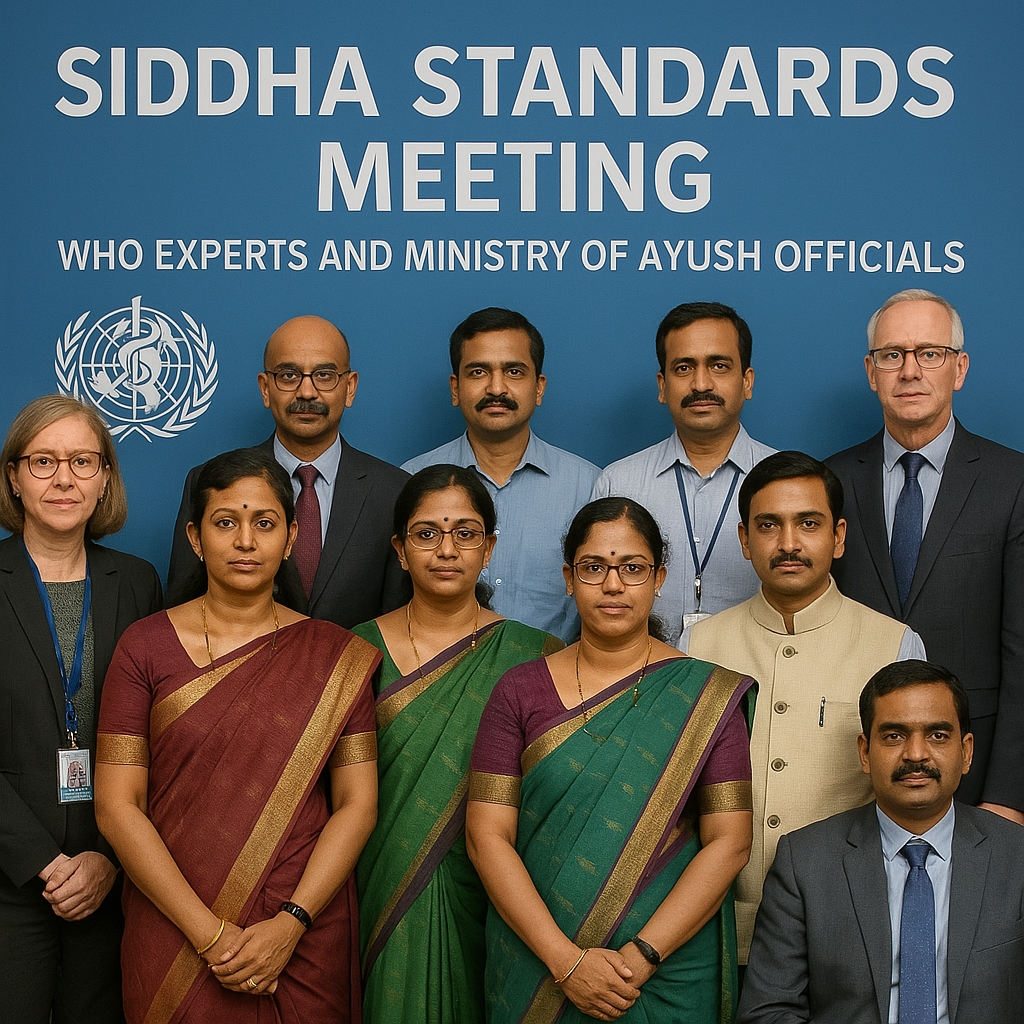
WHO and India Collaborate to Promote Siddha
WHO concluded a landmark expert group meeting on July 25, 2025, that focused on Siddha medicine. The Ministry of Ayush and the Central Council for Research in Siddha (CCRS) organized the event. This collaboration marked a significant step in promoting evidence-based Siddha practices worldwide.
Sixteen global experts from 11 countries, including the USA, UK, Japan, Germany, Canada, and Sri Lanka, attended the hybrid sessions representing all six WHO regions.
Key Leaders Emphasize Scientific Credibility and Tradition
Vaidya Rajesh Kotecha, Secretary of the Ministry of Ayush, delivered the keynote address. He urged countries to adopt harmonized training protocols and clinical standards in Siddha.
“India commits to evidence-based practices in traditional medicine,” he said. “The world needs structured, validated systems to integrate Siddha into mainstream healthcare without losing its cultural essence.”
Ms. Monalisa Dash, Joint Secretary at Ayush, emphasized the growing international interest in Siddha. She described it as a “living tradition with scientific relevance and deep cultural roots.”


Dr. Kim Sungchol, Head of WHO’s Traditional, Complementary and Integrative Medicine (TCI) Unit, praised India’s leadership. He reaffirmed WHO’s goal to integrate Siddha into national health systems while preserving its traditional foundation.
He also recognized India’s technical and financial contributions in drafting WHO’s evidence-based documents for Siddha training and practice.
Experts Finalize Global Standards for Siddha
The two-day meeting focused on finalizing WHO Technical Reports that define standards for Siddha training, practice, and regulation. These reports aim to help countries implement high-quality education and clinical practices for Siddha professionals.
Experts from Japan, Switzerland, Malaysia, UAE, and Singapore shared regional insights. Their contributions refined the final draft, ensuring global relevance while honoring cultural authenticity.
Siddha’s Global Evolution from Ancient Wisdom
Siddha medicine, which originated in Tamil Nadu, stands among the world’s oldest holistic health systems. Its principles—based on diet, lifestyle, herbal remedies, and spiritual wellness—closely align with WHO’s emphasis on preventive healthcare.
Until now, Siddha lacked globally accepted standards. This expert meeting laid the groundwork for structured international recognition and regulation.
India Emerges as a Global Ayush Knowledge Hub
This event solidified India’s role as a global knowledge leader in traditional medicine. It directly supports WHO’s Traditional Medicine Global Strategy 2025–2034, with India playing a pivotal role in shaping global policy and standards.
Secretary Kotecha concluded, “India is not just promoting Siddha. We are helping the world discover it with credibility and confidence.”
What Comes Next for Siddha
WHO plans to release the finalized technical reports later this year. These documents are expected to:
- Guide WHO Member States in adopting standardized Siddha education programs
- Encourage more countries to integrate Siddha into public health systems
- Foster global collaboration in Ayush-related research and training
These developments will help Siddha grow into a globally respected healthcare system—deeply rooted in Indian heritage but adapted for modern times.
Conclusion: A Milestone in Global Traditional Medicine
WHO’s endorsement of Siddha training standards marks a transformative moment in India’s traditional medicine journey. With international cooperation, scientific integrity, and cultural pride, Siddha is on its way to becoming a vital part of global healthcare systems.
India’s leadership and sustained efforts in Ayush systems will ensure ancient wisdom continues to meet modern scientific standards—for the benefit of all.