As global interest grows in fifth-generation fighter jets, India is once again being drawn into conversations around Russia’s stealth fighter—the Su-57. With its advanced radar capabilities, potential for indigenous customization, and future-ready combat applications, many Indian defense analysts believe this jet could become a cornerstone in India’s push toward next-generation aerial warfare.
Here’s why experts are excited about the Su-57, and why India might be wise to invest in it with a unique, self-reliant approach.
A Flying Radar Network
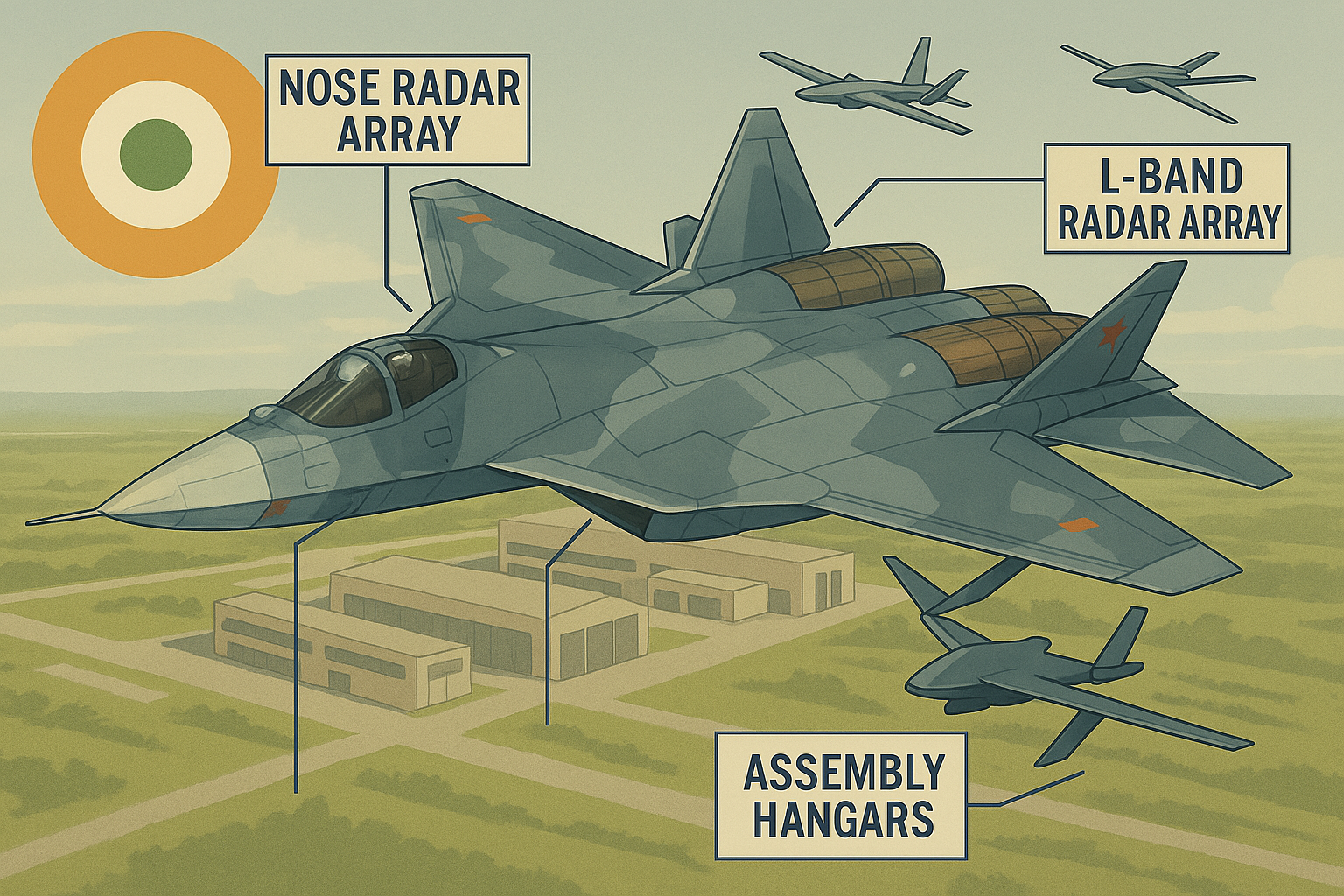
One of the most exciting features of the Su-57 is its radar architecture. The aircraft has space for four separate radar arrays on its fuselage—one in the nose, two on the chin, and one at the rear. When fitted with India’s indigenous radar systems, this could create a full 360° coverage platform. Experts estimate a combination of 5,000 transmit-receive modules (TRMs) could be distributed around the aircraft using GaN-based AESA radar technology.
Additionally, L-band radar arrays embedded in the wings add a layer of early warning against stealth aircraft, enhancing the jet’s battlefield awareness. If integrated properly, the Su-57 could operate as a mini-AWACS (Airborne Early Warning and Control) system, capable of coordinating large-scale air battles.
Indigenous Electronics and Customization
Analysts argue that India should not buy the Su-57 “off-the-shelf,” but instead use it as a canvas for Indian upgrades. The proposed Super Sukhoi upgrade for India’s Su-30 MKIs—which includes Indian mission computers, electronic warfare systems, and indigenous sensors—could serve as a roadmap for the Su-57’s customization.
Incorporating Indian electronics at the outset would not only enhance security and performance, but also reduce dependency on foreign components. It’s also a win for Make in India, giving Indian defense firms a role in a cutting-edge platform.
The Case for a Twin-Seat Variant
Experts are also advocating for India to develop a twin-seat variant of the Su-57. The second seat could serve as an operations console for unmanned teaming. In future wars, manned-unmanned teaming (MUMT) will be a defining strategy. A twin-seat Su-57 could act as a “mother ship,” guiding autonomous drones or loitering munitions toward air or land targets.
This is not science fiction. It’s a logical next step. Having a pilot and a systems operator work together would significantly enhance decision-making, mission flexibility, and combat coordination.
Engine Upgrade Potential
The AL-51 engine—meant for the Su-57—has been a long-awaited development. Experts note that India should acquire these engines not just for the Su-57 fleet, but also for its Su-30 MKIs. The upgraded engines would allow both aircraft to carry heavier electronic payloads and weapon systems. This would extend the Su-30’s operational life and make it a credible platform for MUMT missions as well.
More Freedom Than Rafale
While France’s Rafale is a proven platform, its tight control over customization has frustrated Indian planners. Subsystem integration, weapons testing, and software modifications are often subject to long negotiations. With Russia, India has historically enjoyed greater freedom. India’s involvement in past programs—like the Su-30MKI, MiG-29KUB, and naval Kamov AEW conversions—proved mutually beneficial.
The Su-57, if co-developed with India’s unique requirements in mind, could allow India to mount its own weapons and test new systems without international red tape.
A Smart Leap in Production
Another strategic advantage is the potential production shift. India could convert existing Su-30 production lines to assemble the Su-57 with minimal infrastructure changes. This would cut costs and time significantly. In many ways, it allows India to leapfrog into fifth-generation fighter manufacturing with relatively low investment.
Conclusion
While many details are still under discussion, the Su-57 offers India an opportunity not just to buy, but to shape a future-ready stealth fighter. If the government and defense establishment can align it with India’s push for self-reliance, this jet could mark a turning point in India’s military aviation history.