
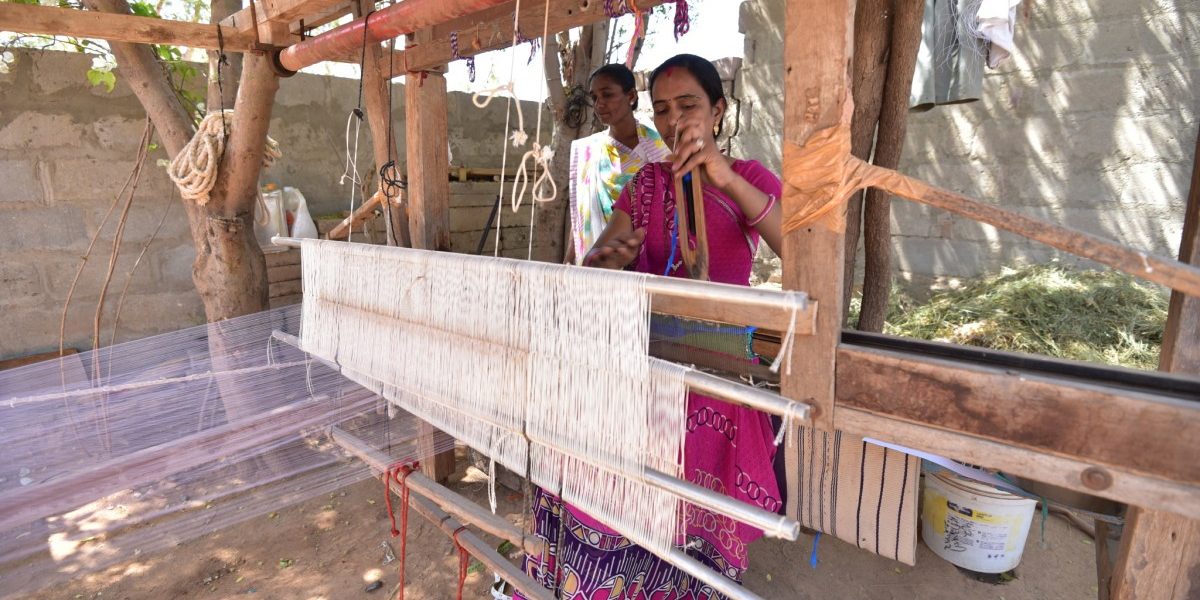
India’s handloom sector is deeply rooted in tradition, craftsmanship, and rural livelihoods. What’s often overlooked, however, is the overwhelming contribution of women in this sector. As per the Fourth All India Handloom Census (2019–20), out of 35.22 lakh handloom workers, more than 25.46 lakh are women. This means women account for over 72% of India’s handloom workforce.
India’s Weaving Women: The Silent Strength
The handloom sector is one of India’s largest unorganized economic activities. It provides both employment and income to millions. Women in handloom are not just helpers—they are designers, weavers, marketers, and entrepreneurs. In many regions, they are the primary breadwinners.
States like Assam, Manipur, and West Bengal are particularly rich in women-led handloom communities. For instance, Manipur has over 2.11 lakh women engaged in weaving, while Assam leads with over 11.79 lakh women contributing to the sector. These numbers highlight the central role played by women in preserving traditional weaving practices.


While the government has not conducted a specific study focused solely on income and working conditions of women in the handloom sector, it has evaluated several schemes that impact them directly. Union Minister of Textiles Shri Giriraj Singh informed the Rajya Sabha that independent evaluations of government schemes reveal promising results.
These studies show an increase in the number of working days, improved earnings, and better working conditions among weavers—especially women. Schemes like National Handloom Development Programme (NHDP) and Comprehensive Handloom Cluster Development Scheme (CHCDS) have played a crucial role in this improvement.
Better Days Through Government Interventions
The Ministry of Textiles has launched several initiatives under the larger umbrella of Atmanirbhar Bharat. These aim to:
- Boost digital marketing through GeM and India Handloom Brand
- Provide upgraded looms and design inputs
- Offer financial assistance and insurance for weavers
- Promote e-commerce platforms for selling handloom products
Such interventions have given women weavers better access to markets, increased demand for their products, and better control over their earnings.
State-Wise Snapshot: Women Weavers Across India
Here’s a quick look at states with a large number of women weavers:
- Assam: 11,79,507
- Manipur: 2,11,327
- West Bengal: 3,68,864
- Tamil Nadu: 1,26,549
- Tripura: 93,589
Even in smaller states like Mizoram and Nagaland, thousands of women are sustaining their families through weaving.
Challenges Still Exist
Despite progress, women in the handloom sector continue to face challenges. Many still work from home-based units with low wages and irregular incomes. Access to raw material, modern equipment, and marketing channels remains limited in some regions. Also, absence of formal contracts means many don’t have job security or social protection.
Way Forward: Why a Dedicated Study Is Needed
While third-party evaluations provide some insight, a dedicated government study focusing exclusively on women in handloom is necessary. Such a study would:
- Identify income disparities across states and genders
- Highlight region-specific challenges and solutions
- Help design targeted welfare schemes
- Ensure equitable access to benefits under textile missions
Real Stories of Change
In Assam’s Nalbari district, a group of women weavers turned their self-help group into a registered handloom cooperative. With support from NHDP, they received modern looms and training. Today, they export stoles and dupattas to Singapore and the UK. Their earnings have doubled in two years.
Similarly, in Tamil Nadu’s Erode district, a cluster of women weavers launched their brand online. Government support helped them register on Amazon Karigar, where their cotton sarees gained huge popularity. They now employ more than 30 rural women full-time.
India’s Handloom: Powered by Women
Handloom weaving is more than a livelihood—it’s cultural heritage. And women are its lifeline. With rising demand for sustainable, handmade products, the role of women weavers is becoming more important than ever. Empowering them means empowering rural India and preserving age-old traditions.
By acknowledging their contribution and addressing their challenges, India can create a more inclusive, fair, and thriving handloom economy.