
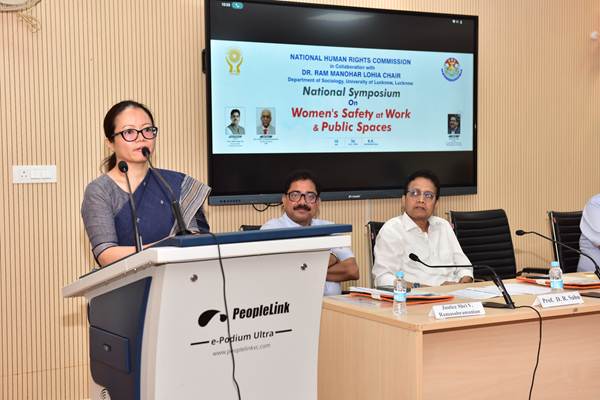
Lucknow, July 28, 2025: The National Human Rights Commission (NHRC) joined hands with the University of Lucknow to host a powerful national symposium on “Women’s Safety at Work and Public Spaces.” Held on July 26, 2025, this marked the second edition of the event, reflecting growing national concern over rising crimes against women across workplaces and public settings.
A Nation Grapples with Reality
In his keynote address, Justice V. Ramasubramanian, Chairperson of NHRC, painted a stark picture. “Despite revering goddesses, India registers around 51 FIRs every hour for crimes against women,” he noted. His speech reminded the audience of the long road to the Prevention of Sexual Harassment at Workplace Act, 2013, and emphasized that awareness must now translate into strong enforcement and systemic reform.


NHRC Joint Secretary Smt. Saidingpuii Chhakchhuak shared her personal experiences. She highlighted how many crimes are subtle and not always violent. “Despite laws, we continue to receive daily reports of gender-based violence,” she said. Her call was clear: India needs stronger policies, better implementation, and a deeper cultural shift.
Education and Empowerment as Catalysts
Prof. S.K. Chowdhury from Lucknow University underlined a vital truth—rights alone are not enough. “We need to build confidence among women to report crimes,” he said. Education, he stressed, must teach gender sensitivity. Dr. P.K. Gupta echoed this sentiment, emphasizing how change must begin at home and in schools.
The Socio-Cultural Angle
Prof. S.M. Patnaik from Delhi University explored how patriarchy and public anonymity breed violence. Quoting Carl Sagan, he warned, “Absence of evidence is not evidence of absence.” He called for early gender sensitization, community empathy, and grassroots-level support systems.
Legal Tools and Tech Integration
Dr. S.N. Sabat, Chairperson of UPSSSC, drew attention to legal provisions and the role of tech in public safety. “We must invest in surveillance and real-time safety systems,” he insisted. Similarly, Prof. Nilika Mehrotra of JNU spoke about the urgent need to redesign public transport systems through a gender-sensitive lens.
Structural Injustice: The Hidden Threat
Throughout the symposium, speakers discussed how systemic bias, gender stereotypes, and weak institutional responses hinder the goals of the Constitution. The consensus was strong—India must move beyond policy documents and into action.
Government initiatives like SHE-Box, One Stop Centres, and Pink Police Booths were acknowledged. But all agreed that these tools require better outreach and usage monitoring.
5 Major Recommendations from the Symposium
- Policy, implementation, and awareness must go hand-in-hand to improve women’s safety.
- Informal sector inclusion is vital. Awareness campaigns should target vulnerable workgroups.
- Family-level sensitisation is essential to transform social attitudes from the ground up.
- Representation of women in decision-making spaces should be ensured for deeper reform.
- Educational institutions must take proactive gender-sensitization measures for youth.
India’s Path Forward
The NHRC reaffirmed its commitment to protecting women’s dignity and rights. “This is not just a policy matter. It’s a societal responsibility,” said a spokesperson. The symposium highlighted that real change will only come when conversations translate into concrete, coordinated actions.
Women’s safety at work and in public is not a privilege—it’s a fundamental right enshrined in our Constitution and aligned with the Universal Declaration of Human Rights. The urgency to uphold this right has never been greater.