
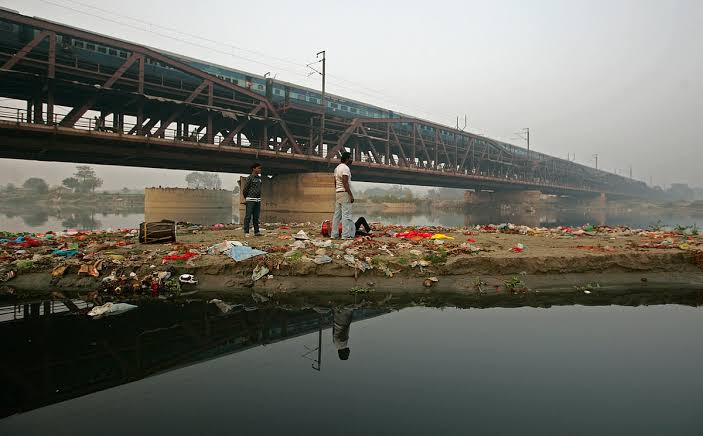
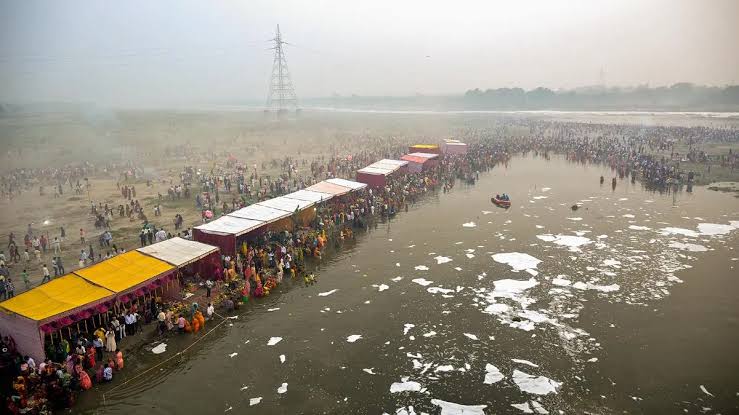

The Yamuna, originating from Yamunotri Glacier in Uttarakhand and passing through Himachal Pradesh and Haryana before entering Delhi, is considered holy by Hindus and central to several cultural festivities such as Chhath Puja. Yet, studies show that downstream of Wazirabad Barrage, the river’s water quality is alarmingly poor, with Fecal Coliform levels exceeding safe limits by up to 32,000 times.
According to the Centre for Science and Environment (CSE), 76% of the river’s pollution load in Delhi comes from a 22 km stretch between Wazirabad and Okhla. Najafgarh drain alone accounts for nearly 70% of the wastewater entering Yamuna, while Shahdara drain adds almost 14% of the pollution load.
Urbanization and Industrial Waste
The riverbanks have been heavily impacted by rapid urban migration since the 1970s. Unauthorised settlements lacking sewage systems discharge untreated waste into stormwater drains, which ultimately flow into Yamuna. Additionally, unregulated industrial effluents further degrade water quality, creating a toxic environment unsuitable for aquatic life.
Delhi currently has over 1,780 unauthorised colonies. Neighboring states contribute to the problem, with several Haryana and Uttar Pradesh drains feeding untreated wastewater into Delhi’s Yamuna stretch.
Temporary Improvements During Floods and Festivals
Monsoon floods can temporarily improve water quality by diluting pollutants. During the 2025 Chhath Puja festival, increased water releases from Hathnikund Barrage upstream provided cleaner conditions for devotees. However, once releases decreased, pollution levels surged again, reaching over 54,000 MPN/100 ml in December 2025.
Government Initiatives and Challenges
Under the Bharatiya Janata Party government, Delhi has prioritized Yamuna rejuvenation. Plans include doubling sewage treatment capacity from 764.2 MGD to 1,500 MGD by 2028 and exploring water diversion from the Ganga to improve flow and reduce pollution. Home Minister Amit Shah reviews the project every 45 days, while Delhi CM Rekha Gupta emphasizes public responsibility in maintaining river purity.
Experts argue that the success of revival depends on strict monitoring, accountability, and addressing pollution at its source rather than temporary cosmetic measures. Dr. Balakrishna Pisupati of UNEP India points to Europe’s successful Seine cleanup, which required 10 years of consistent effort and USD 1.4 billion investment, as a model India could emulate.
The Road Ahead
Despite renewed government focus, sceptics like Himanshu Thakkar of SANDRP warn that the absence of transparency and systemic accountability continues to hinder real progress. With decades of accumulated pollution and complex inter-state water sharing, the challenge of restoring Yamuna to a safe and vibrant river remains formidable. Yet, lessons from global river restoration projects provide hope that coordinated, sustained action could make the dream of a clean Yamuna a reality.