
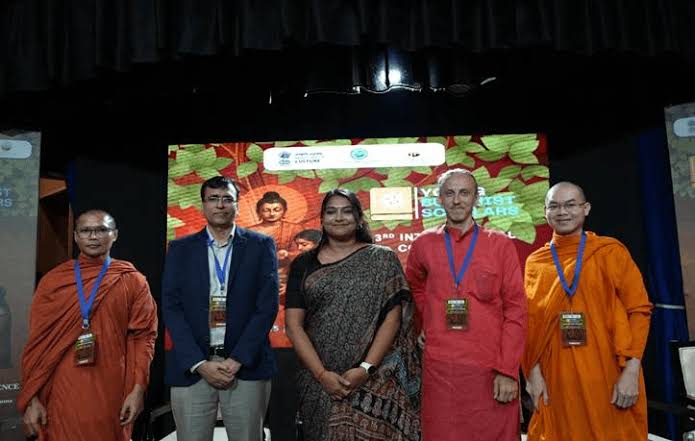
Global Participation and Dialogue
The annual conference brought together young scholars, monks, and academics from Russia, Vietnam, Cambodia, Sri Lanka, Myanmar, Taiwan, and India. Participants engaged in rich dialogues on how the Buddha Dhamma—rooted in compassion, mindfulness, and ethical conduct—can remain relevant in addressing today’s challenges. Discussions emphasized intercultural exchange, technology’s role in education, and practical applications of Buddhist teachings in everyday life.


The conference began with a mangalacharan (invocation), followed by a welcome address from Shartse Khensur Jangchup Choeden Rinpoche, Secretary General of IBC. He highlighted IBC’s role in nurturing young minds while safeguarding the sacred continuity of wisdom (Citta Santati). A special presentation by Yeshi Dawa, Senior Researcher at the 108 Peace Institute, addressed the role of compassion in tackling mental health issues among youth.
A documentary on the Holy Relic Exposition in Vietnam, which attracted nearly 17.8 million devotees earlier this year, was also showcased, underlining the global resonance of Buddha Dhamma.
Core Themes and Insights
Abhijit Halder, Director General of IBC, outlined five essential components for youth: mindfulness, impermanence, compassion, self-realisation, and environmental responsibility. Meanwhile, keynote speaker Prof. K. T. S. Sarao appreciated IBC’s emphasis on the term “Buddha Dhamma” over “Buddhism,” stressing its contribution to ethical global governance. Chief Guest Rana Pratap Singh, Vice-Chancellor of Gautam Buddha University, advocated integrating Buddha Dhamma into science and education curricula to foster leadership, happiness, and sustainable living.
Thematic Panel Discussions
Across four thematic sessions, scholars examined diverse topics, including Emperor Ashoka’s governance model, the Guru-Shishya tradition of knowledge transfer, Buddha Dhamma’s role in shaping ethical artificial intelligence, and the engagement of youth through education and Sangha-led initiatives. These panels emphasized practical solutions for applying Buddhist values in governance, technology, and education.
Concluding Vision
The conference concluded with a Vote of Thanks by Prof. Ravindra Panth, Head of Academics Division at IBC, who underscored the importance of preserving the uninterrupted flow of consciousness (Citta Santati) through collective study and practice. The 3rd ICYBS reaffirmed that Buddha Dhamma remains a powerful guide for shaping ethical futures, building compassionate societies, and addressing pressing global issues.
By combining tradition with modern innovation, the conference sent a strong message: the teachings of the Buddha continue to inspire pathways of peace, sustainability, and wisdom for the 21st century.