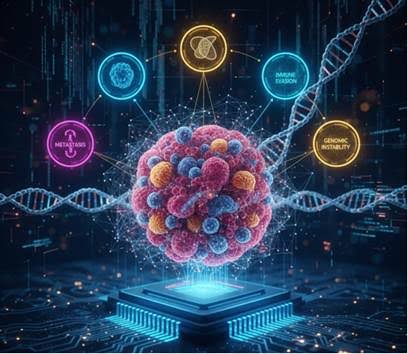
Unlike conventional TNM staging, which relies on tumor size and spread, OncoMark focuses on the hallmarks of cancer—key biological programs that drive malignancy, metastasis, immune evasion, and therapy resistance. By analyzing these molecular traits, the AI predicts tumor behavior and identifies aggressive cancers that may appear less threatening under standard methods.
 OncoMark’s Groundbreaking Approach
The OncoMark framework studied 3.1 million single cells across 14 cancer types, creating synthetic “pseudo-biopsies” representing hallmark-driven tumor states. Led by Dr. Shubhasis Haldar and Dr. Debayan Gupta, the AI model achieved over 99% accuracy in internal testing and maintained above 96% accuracy across five independent cohorts.
Validation on 20,000 real-world patient samples demonstrated OncoMark’s wide applicability, enabling visualization of hallmark activity as cancer progresses. This capability empowers oncologists to tailor treatments targeting specific molecular hallmarks, enhancing precision medicine.
Implications for Personalized Therapy
By revealing active hallmarks in a patient’s tumor, OncoMark guides clinicians to appropriate drugs and interventions. This approach could allow earlier treatment of aggressive cancers, improving survival rates and reducing unnecessary therapies for less harmful tumors.
The study, published in Communications Biology (Nature Publishing Group), marks a significant step toward integrating AI into oncology, bridging the gap between molecular understanding and clinical practice.
Future Outlook
OncoMark represents a convergence of AI, big data, and cancer biology, with the potential to transform oncology care. Its ability to decode complex cellular programs provides a new dimension in personalized medicine, offering hope for earlier interventions, targeted therapies, and improved patient outcomes across diverse cancer types.