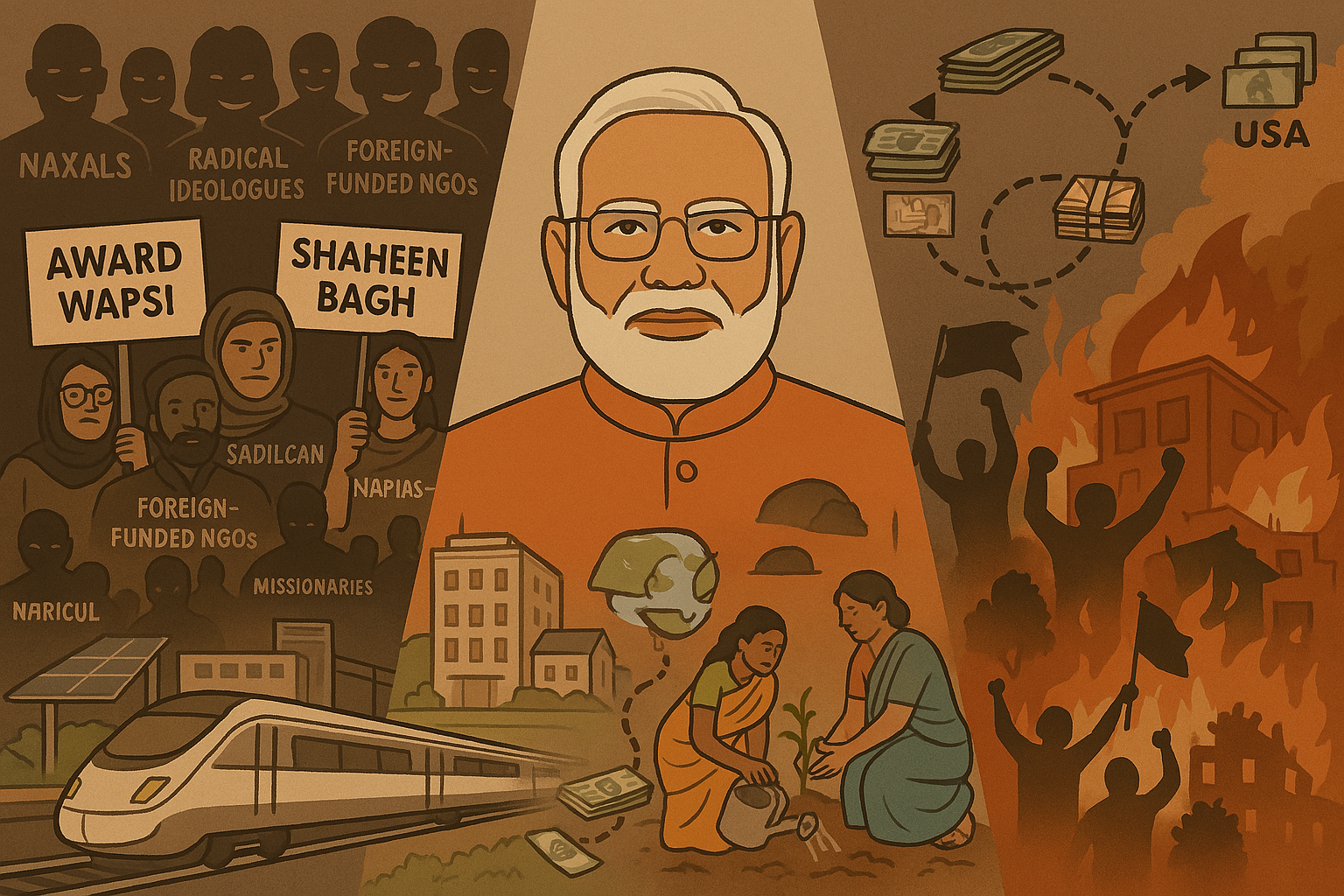
Who Really Opposes Modi—and Why?
Many claim to be opposing Narendra Modi based on policy—citing decisions like the rollback of free ration, agricultural reforms, or the impact of demonetization. But these are often superficial grievances. The deeper and more organized opposition stems from entrenched ecosystems that feel directly threatened by Modi’s governance model.
Let’s break down these groups and their motives:
1. Islamist Networks
Wherever radical Islamist ideology finds fertile ground, there’s often a nexus with anti-national activities—smuggling, terrorism, illegal immigration, and counterfeit currency operations. Countries like Pakistan and Bangladesh have actively supported cross-border operations that destabilize India. Modi’s demonetization in 2016 crippled these networks by invalidating large volumes of counterfeit currency, hitting terror funding hard.
For example, post-demonetization, there was a significant decline in terror activities sponsored by Pakistan in Kashmir. A report by the Ministry of Home Affairs (2017) confirmed a drop in stone-pelting incidents and terror recruitment immediately after the move.
2. Missionary Networks & Economic Saboteurs
Evangelical networks have long operated under the garb of social welfare and education, often pushing aggressive religious conversion. These groups also support economic narratives that hinder self-reliant development in India.
Take Patanjali, a homegrown Ayurvedic company. It faced smear campaigns involving baseless allegations—ranging from bone powder in calcium supplements to fungus in honey—allegedly backed by international pharma lobbies threatened by its success.
Similarly, Baba Ramdev’s midnight eviction from Ramlila Maidan in 2011 wasn’t just about civil disobedience—it was a warning to any indigenous economic uprising that challenges the global corporates’ grip on India’s market.
3. The Naxal-Urban Maoist Ecosystem
The Naxalite movement once drew disillusioned youth with romantic ideas of revolution. Today, it’s a well-funded parallel economy dependent on levies from mining, infrastructure projects, and extortion. The Bhima Koregaon violence in 2018 exposed this network in shocking detail.
Case Study: Bhima Koregaon & Urban Naxals
-
The incident, portrayed as a Dalit uprising, allegedly had the involvement of top Naxal ideologues like Milind Teltumbde, Kobad Ghandy, and civil society sympathizers.
-
Kobad Ghandy, educated at the elite Doon School, became a top strategist for Maoist insurgents.
-
Teltumbde was linked to organizing attacks on security forces across Jharkhand and Chhattisgarh.
-
His brother, Anand Teltumbde, married to B.R. Ambedkar’s granddaughter, has faced scrutiny over alleged links with these networks.
The government’s crackdown post-Bhima Koregaon, including the arrest of Kobad Ghandy in 2017, exposed the urban face of left-wing extremism, including some academics and journalists.
4. Political Opportunists and Dalit Radicalization
Post-2014, with the BJP gaining ground among backward classes and tribals, leftist parties and regional outfits have lost traditional vote banks. In response, there’s been a shift in strategy—targeting Dalits through identity politics and manufactured victimhood.
Events like Rohith Vemula’s suicide, Una flogging, and Dalit assertion at Bhima Koregaon were used to stoke sentiment. Yet behind the slogans of justice often lurks political engineering.
For instance:
-
Prakash Ambedkar, grandson of B.R. Ambedkar and a key figure behind the 2018 Bhima Koregaon event, is accused of aligning with left-wing elements like the banned CPI (Maoist).
-
The call for a Maharashtra Bandh just two days after the violence further politicized the issue.
5. Economic Mafias and Corrupt Ecosystems
From sand and coal mafias to transfer-posting rings and education rackets, India has long been burdened by informal power structures. Many of these thrived under previous regimes due to lack of accountability.
Modi’s aggressive digitization, GST enforcement, and direct benefit transfers (DBT) cut off the supply chains for these groups. As a result, sectors like:
-
Real estate (targeted via RERA),
-
Mining (via stricter environmental oversight), and
-
Education (via NEP 2020 and tighter UGC norms),
have seen reforms—angering those who profited from corruption.
Media and the Narrative Game
Part of the backlash also comes from media houses and platforms that lost their traditional influence. For example, portals like The Wire and NDTV have often taken sympathetic positions toward individuals like Kobad Ghandy and movements like Shaheen Bagh, framing them as expressions of dissent, while ignoring evidence of deeper subversion.
The Shaheen Bagh protest, lauded as a democratic movement, also saw support from international figures like Greta Thunberg, Rihanna, and even adult content celebrities like Mia Khalifa—all tweeting support for Indian farmer protests in 2021, often citing misinformation leaked via coordinated “toolkits.”
The Farmer Protests & “Andolanjeevis”
The 2020–21 farmer protests were framed around opposition to three farm laws. However, figures like Yogendra Yadav (Swaraj Abhiyan) and international actors linked to Khalistani groups hijacked the narrative. PM Modi termed them “andolanjeevis” (professional protestors)—a term reflecting seasonal activism divorced from ground realities.
Demonetization: Crippling the Underground Economy
In hindsight, the 2016 demonetization wasn’t just a fiscal reform—it was a surgical strike on parallel economies:
-
13.5 lakh crore came back into the system officially.
-
Fake currency, largely routed through Pakistan, became useless.
-
Maoist and terror groups lost liquidity, reducing their operational capacity significantly.
Noted Naxals like Chirag Da were neutralized in counter-operations post-demonetization, highlighting how deeply finances and violence are intertwined.
Adani, Ambani, and the Economic Nationalism Debate
Modi’s critics often target industrialists like Gautam Adani and Mukesh Ambani, labeling them symbols of crony capitalism. However, these conglomerates are also India’s largest employers and taxpayers, and they power core infrastructure like energy, telecom, logistics, and ports.
Foreign-backed NGOs and eco-activist groups have consistently opposed Adani projects, especially in sensitive areas like:
-
The Carmichael coal mine in Australia,
-
Port projects in Kerala,
-
And solar energy corridors in Rajasthan.
Why? Because a self-reliant India threatens Western and Chinese control over global supply chains.
Conclusion: A Battle of Ideas and Interests
India’s political discourse under Modi isn’t just left vs right, or secular vs nationalist. It’s a battle between an emerging sovereign, self-reliant India and a nexus of ideological, economic, and foreign forces that thrived on its disunity and dependence.
Many people oppose Modi because of tangible policies. But a far more sinister ecosystem also works tirelessly to destabilize India from within. From foreign-funded NGOs to urban Naxals, from radical Islamists to identity politics peddlers, the lines are drawn.
And it’s not just Modi they oppose—it’s a confident, rising India that refuses to be colonized again—economically, intellectually, or culturally.
References & Sources:
-
Ministry of Home Affairs Reports on Left Wing Extremism (2016–2022)
-
Supreme Court proceedings on Bhima Koregaon accused (2018–2021)
-
The Wire and NDTV articles on urban Naxal cases and related rebuttals
-
“Urban Naxals” by Vivek Agnihotri (2018)
-
India Today: “Kobad Ghandy’s Journey from Elite Schools to Maoist Ranks”
-
PIB India: Press Releases on Demonetization and Fake Currency
-
World Bank & IMF reports on India’s post-2016 economic performance
-
Indian Express: Coverage of Shaheen Bagh, Farmer Protest Toolkits
[Inspired by a few posts on SM]