RSS Chief Drops a Line — and a Bombshell
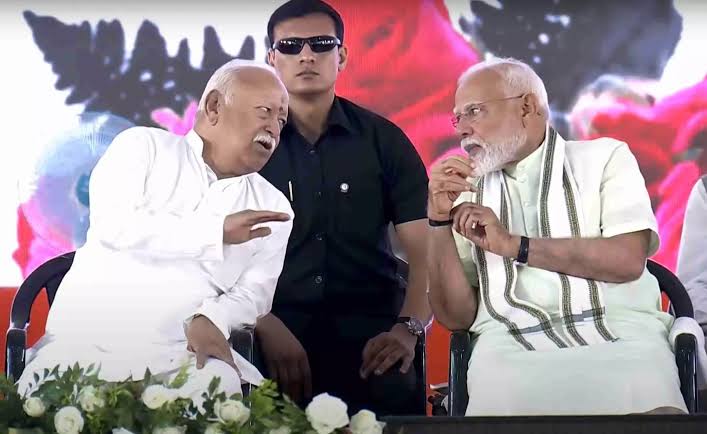
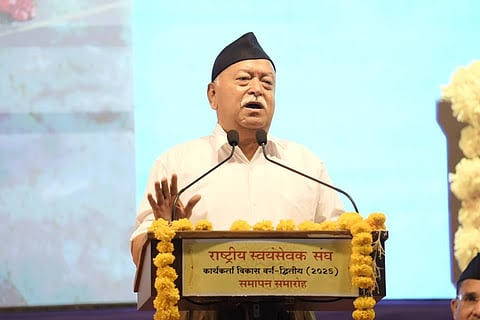
Mohan Bhagwat, chief of the Rashtriya Swayamsevak Sangh (RSS), has stirred political speculation by suggesting leaders should consider retiring at 75. He made this comment in Hindi during a speech largely delivered in Marathi—clearly intentional, not a slip of tongue.
The timing is striking. Prime Minister Narendra Modi turns 75 on September 17, 2025. While Bhagwat didn’t name Modi, the implications are hard to miss. Still, insiders caution against reading too much into it. The BJP, and by extension the Sangh, may apply this principle to many — but not necessarily to Modi.
 The Modi Exception in BJP-RSS Dynamics
The BJP has followed a silent tradition of sidelining senior leaders past 75. We’ve seen it before — L.K. Advani, Murli Manohar Joshi, and others were eased into a “Margdarshak Mandal,” a guiding elders group.
But Modi is not like the others. He commands both electoral charisma and organizational control. In the post-2014 era, his dominance within the BJP and RSS has grown to historic levels. No other leader has managed this kind of hold over both party and ideological parent.
Historical Parallel: When Sudarshan Pushed Vajpayee & Advani
Bhagwat’s words evoke memories of a similar moment in 2005. Then RSS chief K.S. Sudarshan had urged Atal Bihari Vajpayee and L.K. Advani to step aside to allow younger leadership.
It was controversial, but Sudarshan’s intervention catalyzed change. Out of that vacuum rose names like Rajnath Singh, Nitin Gadkari, Sushma Swaraj, and of course, Narendra Modi.
Modi’s Rise: BJP’s HR Legacy in Action
The BJP has long followed a merit-based leadership evolution. It doesn’t promote dynasties. Instead, the Sangh’s shakha system nurtures leaders from the grassroots. Modi himself is the finest example of this pipeline.
Between 2002 and 2014, BJP party presidents like Venkaiah Naidu (53), Rajnath Singh (54), Nitin Gadkari (48), and Amit Shah (49) came to power in their prime years. Contrast that with Congress, where Sonia Gandhi remained party chief till 76, and Mallikarjun Kharge is now leading at 80.
Post-2014: The Youth Bench Gets Deeper
The pattern continued after BJP’s 2014 victory. Young chief ministers like Yogi Adityanath, Pushkar Dhami, and Himanta Biswa Sarma took charge. The average age of BJP CMs sworn in post-2019 is just over 51.
Meanwhile, the Congress remains saddled with veterans like Siddaramaiah in Karnataka. Some of its younger faces have either quit or remain disillusioned within.
No Written Rule, But Strong Signals
There is no official retirement age in the BJP. The so-called ‘75-year rule’ exists more in whispers than in party constitution. Yet, it has been used to explain the exit of senior leaders and ministers in the past.
Interestingly, not everyone was retired post-75. Hema Malini was fielded in 2024 from Mathura despite crossing the age threshold. Ministers like Kalraj Mishra were given gubernatorial roles.
Anandiben Patel is the only senior leader who publicly cited age as a reason for stepping down, back in 2016.
Will Bhagwat Walk the Talk?
Bhagwat turns 75 on September 11. If he retires soon after, it would show that he follows what he preaches. But it could also place quiet pressure on Modi to address succession within the BJP.
Still, no one expects a formal challenge to Modi’s leadership. He remains the BJP’s most popular vote-getter and faces no internal rebellion.
2029: A Date Modi Is Eyeing
With eyes on the 2029 general elections, Modi shows no sign of slowing down. At 79, he would be the same age as Donald Trump today — and appears fitter.
Those waiting in the wings — some senior ministers, a few chief ministers — are watching. Quiet ‘primaries’ may already be unfolding behind the scenes, but none would dare express ambition publicly.
Conclusion: Power Lies with the Exception
Bhagwat’s retirement line was simple but powerful. It signals a desire to renew leadership. But with Modi firmly in command, the BJP’s succession is unlikely to follow a fixed age rule.
In India’s most disciplined party, the exception now defines the rule.