He emphasised that government efforts now extend far beyond policy announcements. Programmes under the science and technology ministries, such as BIRAC, national innovation missions and sector-driven startup networks, act as structured bridges linking ideas with funding, markets and industry experts. These platforms, he said, are helping convert ideas into deployable technologies across fields such as biotechnology, AI, digital health and agritech.
Dr Singh underlined the need to normalise failure in research and development. Innovation, he said, grows out of experimentation and risk, and India must cultivate a culture that accepts both setbacks and bold attempts. Without this mindset, startups cannot scale globally or compete in high-technology sectors.
 India’s Transition to an Innovation-Led Economy
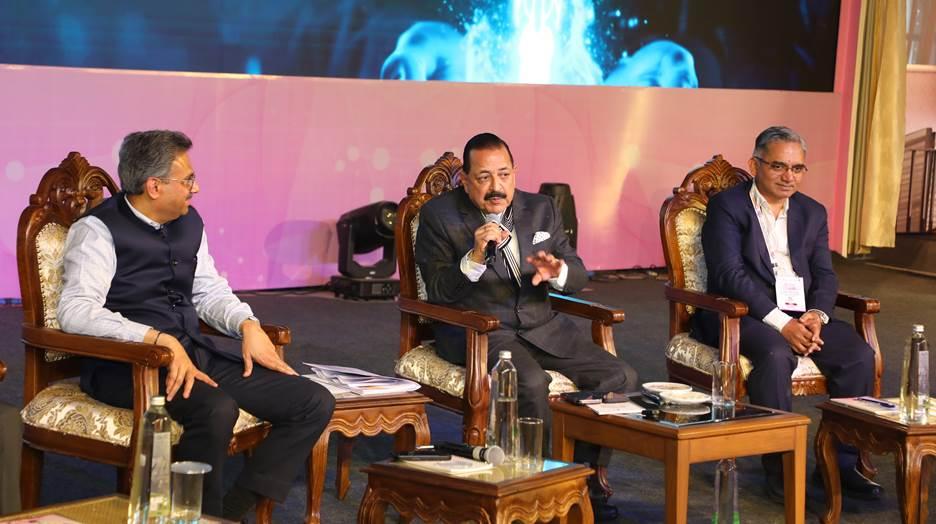
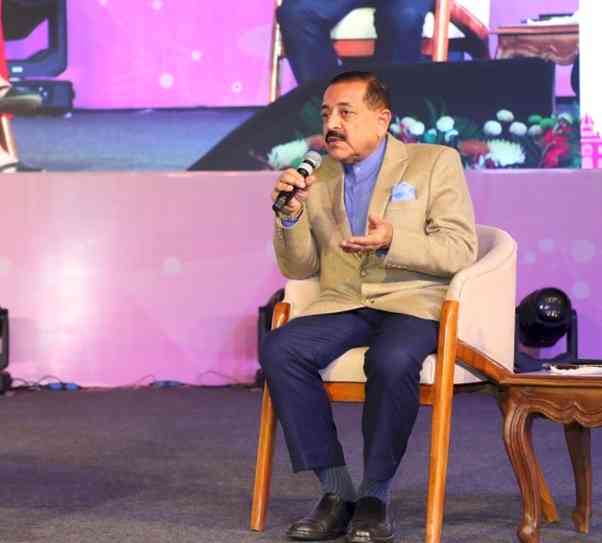
During a separate Fireside Chat at the festival, Dr Singh said India is now shaping global trends instead of following them. He noted that the last decade has brought a shift in policy direction and national purpose, positioning science, technology and innovation at the centre of economic growth.
He pointed out that India has never lacked talent, but the country earlier lacked clear pathways and support structures. Today, India is asserting leadership in emerging sectors such as regenerative sciences, nuclear innovations, next-gen space technologies and grassroots biotechnology.
The Minister highlighted the launch of the new national R&D fund as a major step to unlock deep-tech innovation. This fund will support high-risk, high-impact research in areas traditionally inaccessible to private players, including space and nuclear technology. By offering long-duration, low-interest support, the fund will allow companies to mature scientifically before seeking commercial independence.
Reforms Driving Innovation
Responding to regulatory concerns raised by young innovators, Dr Singh said the government is steadily moving towards deregulation, decriminalisation and de-licensing across sectors. These reforms are designed to free entrepreneurs from excessive compliance pressures and enable them to prioritise innovation.
He offered examples of India’s transformation in the space and nuclear sectors. From a time when even media access was restricted at rocket launch sites, India today hosts nearly 400 space startups, many recognized globally. Similarly, innovations in nuclear science are improving lives through cancer-care networks, water purification and scalable public services.
The Minister also highlighted how digital inclusion and affordable connectivity have democratised opportunity. Students from non-metropolitan regions are competing at national and global levels, as demonstrated by the diverse backgrounds of recent UPSC toppers.
Mentorship as the Cornerstone of Startup Success
Dr Jitendra Singh repeatedly stressed that mentorship must be strengthened across schools, colleges and early-stage incubators. Young entrepreneurs, he said, often have strong ideas but lack the clarity of purpose, business fundamentals and strategic direction that come from expert guidance.
He added that government programmes aimed at students especially girls are being expanded to identify promising talent at a younger age. Early handholding, he said, can help innovators avoid common pitfalls and accelerate their journey from prototype to market.
As IISF continues in Panchkula, the Minister said the festival serves as a platform where scientists, entrepreneurs and policymakers converge to exchange ideas. He emphasised that nurturing curiosity, building confidence and encouraging risk-taking are as important as funding or infrastructure in shaping an innovation-driven India.
Dr Singh concluded that India is standing at its strongest position in decades, and the coming era will belong to innovators who combine scientific imagination with national purpose. With global recognition rising and domestic capabilities expanding rapidly, India’s innovation economy, he said, is poised to lead the world by 2047.