
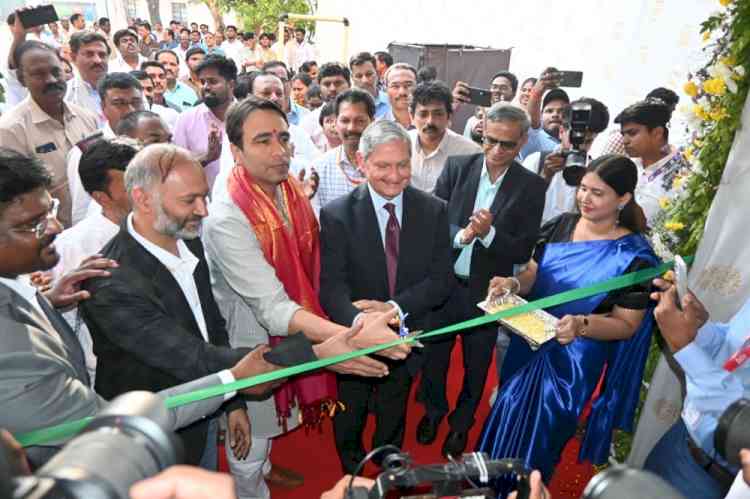
 Why COLTE matters for India’s logistics growth
India’s logistics sector is undergoing rapid transformation, driven by the National Logistics Policy, PM Gati Shakti and large multimodal infrastructure investments. Shri Jayant Chaudhary emphasised that infrastructure alone is not enough: “This transformation can only be sustained if we build a workforce that is as modern and future-ready as the systems we are creating.” COLTE Hyderabad responds to that need by equipping learners with hands-on skills for modern supply chains.
Industry-designed curriculum and job pathways
CENTRE’s curriculum — co-developed by LSC and industry experts — targets roles in EXIM operations, warehouse management, forklift operation and supply chain execution. Training modules blend core logistics fundamentals with Industry 4.0 topics such as IoT in warehousing, digital inventory systems, telematics and automation. Graduates will be prepared for entry and mid-level roles that are in high demand across manufacturing, e-commerce and third-party logistics providers.
Simulation labs, AR/VR and technology-led learning
COLTE Hyderabad brings advanced simulation labs to the NSTI campus: truck and forklift simulators, warehouse operation mockups and AR/VR modules that recreate real operational environments. Redington Foundation’s approach, proven at its Chennai centre, combines immersive practice with digital assessments to accelerate job readiness and reduce on-the-job training time for employers.
Partnership model: Redington Foundation and LSC
The centre is a CSR-led initiative by Redington Foundation in partnership with the Logistics Sector Skill Council. Redington officials highlighted the Chennai centre’s success — high engagement, strong industry alignment and measurable placement outcomes — as justification for scaling to Hyderabad, one of the country’s fastest-growing logistics hubs.
Focus on employability and local impact
Beyond technical training, COLTE will include soft skills, safety protocols, certification pathways and placement linkages with local employers. The centre aims to enhance employability for Telangana’s youth, especially those from economically vulnerable backgrounds, by offering certified courses aligned to National Skill Qualifications Framework (NSQF) levels.
Scaling skills for a technology-driven sector
Automation and digital supply chains are reshaping logistics roles. Rather than displacing workers, COLTE’s model trains people to work with automated systems — from operating mechanised forklifts to interpreting warehouse management dashboards. This re-skilling approach supports both job creation and productivity gains for the sector.
Policy alignment and national skilling architecture
The launch reinforces the Ministry of Skill Development & Entrepreneurship’s strategy to build sector-specific Centres of Excellence. COLTE complements national initiatives by strengthening demand-led skilling, driving industry-academia partnerships, and creating replicable models across states to meet the logistics sector’s projected talent needs.
What to expect next
COLTE Hyderabad will begin rolling out short-term and modular courses, onboarding trainers and scheduling industry immersion opportunities. Stakeholders expect the centre to help place trained candidates across warehousing, last-mile delivery, export-import support and supply-chain analytics roles, feeding Telangana’s growing logistics ecosystem.