 What the India–EU Trade Deal Covers
The agreement aims to enable near-free trade in goods between the 27-member European bloc and the world’s most populous nation. According to official statements, tariffs on a wide range of European exports—including chemicals, machinery, electrical equipment, aircraft, and spacecraft—will be eliminated or sharply reduced in a phased manner.
One of the most significant breakthroughs involves the automobile sector. Import duties on European cars, which currently go as high as 110 percent, will be reduced to 10 percent under a quota of 250,000 vehicles. This quota is substantially larger than similar concessions India has granted in past trade deals.
In return, almost all Indian exports are set to receive preferential access to European markets. Key beneficiaries include textiles, leather goods, marine products, handicrafts, gems, jewellery, and several categories of processed food.
Balancing Growth With Domestic Priorities
Indian officials have emphasised that while the deal opens up vast export opportunities, sensitive sectors have been carefully protected. Dairy, cereals, poultry, soy meal, and certain fruits and vegetables remain shielded to safeguard farmers and domestic producers.
Products such as tea, coffee, spices, and value-added food items are expected to gain from tariff reductions, helping Indian exporters expand their footprint in one of the world’s most lucrative consumer markets.
Brussels, meanwhile, has highlighted that the agreement will support investment flows, improve regulatory cooperation, and deepen supply-chain integration between Indian and European businesses.
Mobility, Services, and Strategic Cooperation
Beyond goods, the India–EU trade pact includes a mobility framework designed to ease short-term travel for skilled professionals. This is expected to benefit Indian IT professionals, engineers, researchers, and service providers seeking opportunities across Europe.
Prime Minister Modi said the agreement would boost manufacturing, services, and innovation while making it easier for Indian farmers and small businesses to access European markets.
The deal also comes alongside parallel discussions on security, defence, and climate cooperation. India and the EU are working on a draft security partnership covering maritime security, cyber threats, defence dialogue, and trusted supply chains.
Geopolitical Context and Global Trade Shifts
The timing of the agreement is significant. Both India and the EU are navigating heightened economic and geopolitical pressures, particularly due to rising protectionism and tariff disputes involving the United States.
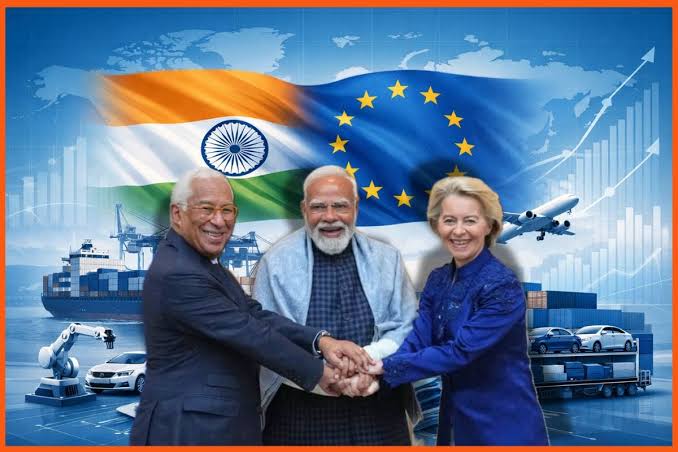
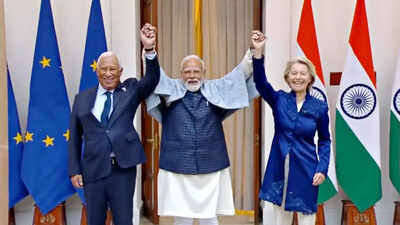
India continues to face steep tariffs imposed by the US, while the European Union has recently sparred with Washington over trade and geopolitical issues. European Council President António Costa said the deal sends a strong global message in favour of cooperation over protectionism.
Von der Leyen described the pact as a partnership between “two giants” choosing collaboration as the best response to global challenges.
Trade Volume and Long Road to Agreement
The European Union is India’s largest trading partner in goods, with bilateral merchandise trade touching approximately $136 billion in 2024–25. Trade between the two sides has nearly doubled over the past decade.
Negotiations for a comprehensive trade agreement began in 2007 but stalled in 2013 over disagreements on market access, tariffs, and regulatory standards. Talks were formally revived in July 2022, with intensified efforts in recent months to finalise pending chapters.
The agreement will now undergo legal vetting and must be approved by the European Parliament and the European Council before formal signing later this year.
India’s Expanding Trade Diplomacy
The India–EU deal adds to a series of recent trade agreements signed by New Delhi. Over the past year, India has concluded major pacts with the UK, Oman, New Zealand, and Australia, while a 2024 agreement with the European Free Trade Association has already come into force.
As global supply chains realign, the India–EU free trade agreement is expected to play a critical role in positioning India as a key economic partner for Europe in the Indo-Pacific and beyond.