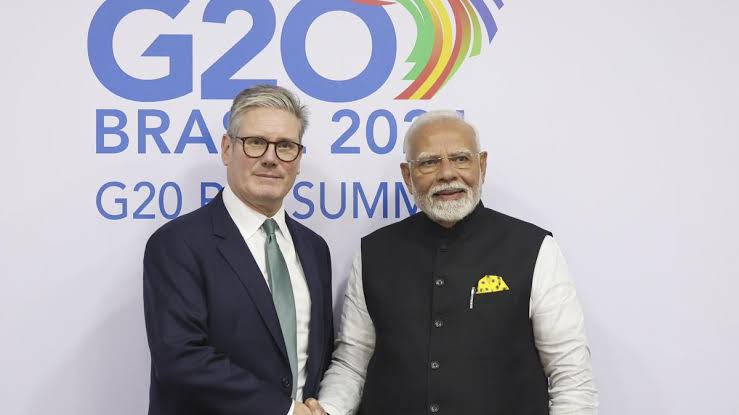
New Delhi: As Prime Minister Narendra Modi begins his UK tour, both India and the UK stand at the threshold of a historic moment — the finalisation of the long-awaited India-UK Free Trade Agreement (FTA). This visit is more than a handshake. It’s a strategic step toward deeper economic, diplomatic, and security cooperation.
Last-Minute Scrutiny Before the Big Leap
According to Foreign Secretary Vikram Misri, the FTA is undergoing final “legal scrubbing” and last-minute adjustments. While no formal confirmation has been made, both nations are optimistic about the agreement being signed during Modi’s visit to London on July 24.
This landmark pact aims to eliminate tariffs on 99% of Indian exports and enhance access for UK-made goods in India. British businesses, especially whisky and auto manufacturers, eagerly await the agreement’s enforcement.
 India-UK Trade: A Win-Win Story
As of FY 2023–24, bilateral trade between the two countries crossed USD 55 billion. The UK is India’s 6th largest investor, with a cumulative investment of USD 36 billion. Conversely, India has invested nearly USD 20 billion in the UK, with 1,000 Indian firms employing over 100,000 people.
The FTA will likely double this trade volume, streamline regulatory barriers, and inject fresh energy into industries across both nations.
What’s on the Agenda? Trade, Technology, and Tough Talks
Beyond trade, PM Modi and UK PM Keir Starmer are expected to discuss:
- Energy Security: India’s stance against double standards in energy trade
- Defence Cooperation: Joint exercises and military training exchanges
- Technology: Collaboration on AI, telecom, semiconductors, and biotechnology
- Khalistani Extremism: Addressing India’s concerns over UK-based separatist movements
- Extradition Issues: India’s push to return economic fugitives
Misri stressed India’s call for a “clear-eyed perspective” on sanctions and global energy trade, especially as the EU and US attempt to isolate Russia. India maintains energy security as its top priority, rejecting policies that discriminate against its sovereign needs.
Why the FTA Matters Now
This trade pact is not just about economics. It is a symbol of post-Brexit diplomacy. For the UK, it’s the largest FTA since leaving the EU. For India, it marks another step in expanding its global trade footprint and counterbalancing Chinese influence in the West.
Also, with Starmer’s Labour Party signaling renewed global engagement, India sees this as an opening to solidify strategic bonds while addressing sensitive issues like diaspora safety and cross-border fugitives.
Energy Diplomacy in a Polarised World
Modi’s visit occurs amidst renewed Western sanctions on Russia, which may affect countries trading with Moscow. India remains firm. Misri clarified that the UK hasn’t applied “secondary sanctions” so far, but India continues to advocate for fairness in global energy diplomacy.
“Europe faces a serious security issue,” Misri said, “but the rest of the world is also facing existential challenges.” India’s message is clear: global rules should apply equally.
Beyond London: The Regional Relevance
PM Modi’s UK visit isn’t just about London. It sets the stage for his follow-up visit to the Maldives, further strengthening India’s Neighbourhood First Policy and regional outreach in the Indo-Pacific. This makes the tour a blend of economic diplomacy and strategic recalibration.
Conclusion: A High-Stakes Diplomatic Play
Whether or not the FTA is signed during the visit, this trip is symbolic of India’s growing global confidence. With trade, tech, and energy on the table — and thorny issues like extremism and extradition not being avoided — this is diplomacy at its boldest.
The India-UK Free Trade Agreement is not just a deal. It’s a declaration — of economic synergy, strategic trust, and shared vision for the future.