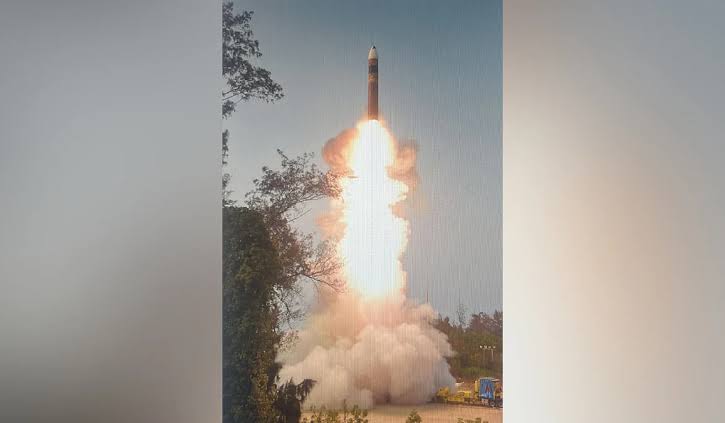
What is Agni-5?
The Agni-5 is one of India’s most advanced missiles. Developed by the Defence Research and Development Organisation (DRDO), it is designed to carry nuclear warheads over 5,000 kilometres. This range covers much of Asia and beyond.
The missile uses modern navigation, propulsion, and guidance systems. It also carries Multiple Independently Targetable Reentry Vehicles (MIRVs), allowing it to release several warheads in different directions.
Key Features of Agni-5
- Range: Over 5,000 km, with work underway for a 7,500 km variant.
- MIRV Capability: Can carry and deploy up to three nuclear warheads.
- Technology: Advanced propulsion, navigation, and guidance systems.
- Future Enhancements: Integration of bunker-buster technology.
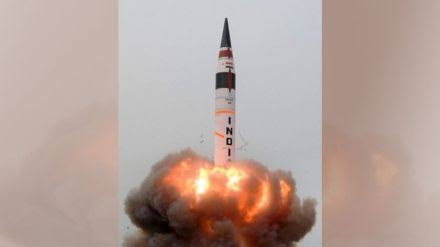 Why the Test Matters
The successful test reaffirms India’s commitment to a credible minimum deterrence strategy. It demonstrates operational readiness under the Strategic Forces Command. According to the Ministry of Defence, the system has met all technical parameters.
This test also strengthens India’s nuclear deterrence posture. It signals that India is prepared to defend its sovereignty in a volatile regional environment.
Pakistan’s Concerns
Pakistan reacted with alarm. The Strategic Vision Institute in Islamabad warned that India’s growing missile programme poses “serious risks” to regional stability. It highlighted that India’s missile development gained momentum after joining the Missile Technology Control Regime (MTCR) in 2016.
Pakistan fears that future versions of Agni-5, with ranges above 8,000 km, could target global cities, including Washington, Moscow, and Beijing. Islamabad also worries about India’s expanding naval arsenal, particularly submarine-launched ballistic missiles.
Global Implications
India’s missile advancements go beyond South Asia. Analysts believe the Agni-5 signals India’s global ambitions. It could reshape international strategic calculations, especially in Asia-Pacific security.
Countries like China and the United States are watching closely. China sees Agni-5 as part of India’s effort to counter its growing influence. Meanwhile, the U.S. may welcome India’s rising defence role but will monitor regional tensions carefully.
Looking Ahead
DRDO is already working on next-generation variants of Agni-5. These may include improved warhead capacity and bunker-buster capabilities. Such advancements would extend India’s strike options against fortified or underground targets.
At the same time, India continues to balance its defence modernisation with its stated nuclear policy of “No First Use” and “credible minimum deterrence.”
Conclusion
The Agni-5 missile test highlights India’s growing technological edge and defence preparedness. While it boosts national security, it also raises fresh concerns for neighbours, especially Pakistan. The test is not just about defence—it is about India asserting its role as a global strategic player.