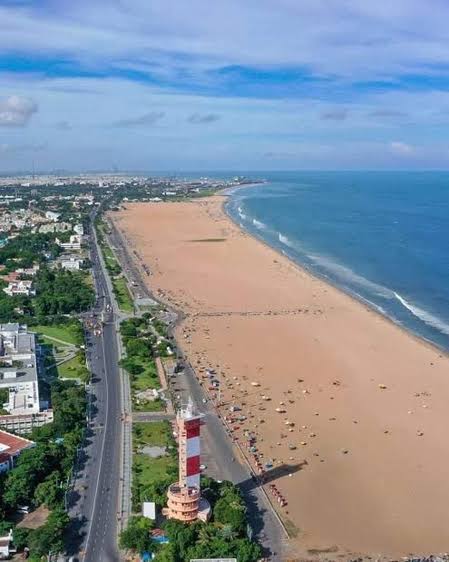
 Protest on the Sands
On the morning of January 23, hundreds of vendors a majority of them women assembled near the Vinayakar Temple area on Marina Beach. Their shops remained shuttered as they met to discuss the civic body’s plan. The gathering soon turned tense when a few vendors attempted to reopen briefly after tourists requested drinking water, only to close again amid growing commotion.
Nearly 45 minutes into what was intended to be a three-hour meeting, the vendors began marching toward the office of Chepauk-Thiruvallikeni MLA and Deputy Chief Minister Udhayanidhi Stalin. Carrying petitions, they demanded immediate government intervention to protect their right to livelihood.
Blue Flag Certification vs Livelihood
The Blue Flag Certification, administered by the Denmark-based Foundation for Environmental Education, is awarded to beaches meeting strict standards related to cleanliness, waste management, safety, and environmental education. While the certification promises global recognition and increased tourism, its implementation has raised concerns in densely populated urban beaches like Marina.
As part of the second phase of the initiative, the Chennai Corporation has already removed 28 shops from areas identified for certification. Officials maintain that regulated vending zones are essential to meet environmental benchmarks. Vendors, however, insist that compliance should not come at the cost of social justice.
“We are not against cleanliness or tourism,” said a senior vendor leader. “All we ask for are clearly marked vending zones where we can continue our work legally and with dignity.”
A History of Contestation
Marina Beach has long been a contested public space, shaped by decades of protests, court rulings, and civic activism. Earlier attempts to evict vendors in the name of public safety and aesthetics have repeatedly faced legal challenges, leading to negotiated settlements that sought to balance livelihoods with regulation.
Urban planners and social activists warn that drastic reductions without rehabilitation plans could deepen economic distress. Many vendors belong to marginalised communities and have worked on the beach for generations, passing stalls down within families.
According to experts, inclusive urban planning rather than exclusion is key to sustaining both heritage spaces and local economies.
Government Response Awaited
State government officials have acknowledged receipt of vendor petitions but are yet to announce a concrete solution. Sources indicate that discussions are underway to explore alternatives such as staggered vending hours, redesigned kiosks, or expanded vending zones outside core Blue Flag areas.
Meanwhile, vendors remain anxious as enforcement measures continue. With Republic Day celebrations and increased tourist footfall approaching, tensions on the beach are expected to remain high.
For now, Marina’s sands bear witness to yet another struggle one that pits global standards against grassroots survival.