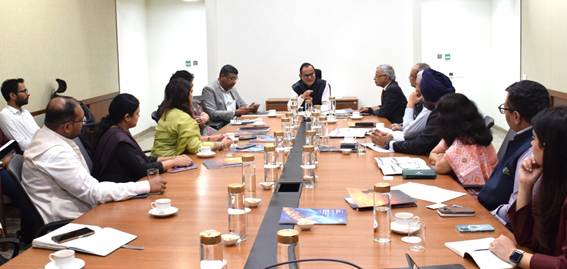
The event was attended by senior officials including Shri S. Krishnan, Secretary, Ministry of Electronics and Information Technology (MeitY), Shri S.C.L. Das, Secretary, Ministry of MSME, Dr. Parvinder Maini, Scientific Secretary, OPSA, and Mr. Anindya Banerjee, Advisor, Ministry of Agriculture.
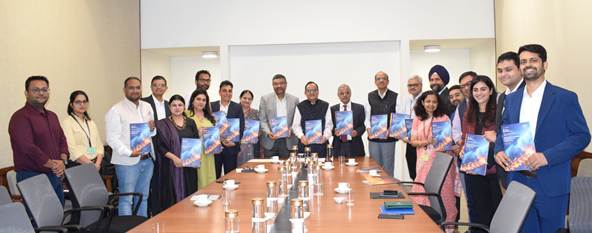 AI for India 2030: Driving Responsible AI
The AI for India 2030 initiative, led by the Centre for the Fourth Industrial Revolution (C4IR) India, World Economic Forum, aims to create scalable, inclusive, and responsible AI frameworks for India’s key sectors. Guided by OPSA and MeitY, the initiative focuses on actionable strategies that integrate government, industry, startups, and front-line stakeholders.
AI Playbooks for Agriculture and SMEs
The Future Farming in India playbook is designed to boost agricultural productivity, manage risks, and improve market access for millions of farmers. Using the IMPACT AI framework, governments provide enabling policies, industry delivers solutions through sandboxes, and frontline workers implement AI tools in local languages for effective adoption.
The Transforming Small Businesses playbook focuses on democratizing AI for SMEs, addressing productivity, market access, and credit challenges. The roadmap guides businesses from awareness to action, offering AI maturity indices, tools, and marketplaces, while celebrating early adopters to encourage wider adoption.
White Paper on AI Sandbox Ecosystem
The AI Sandbox White Paper provides strategic and operational frameworks for testing AI solutions in controlled environments. It ensures that innovations are secure, reliable, and aligned with India’s priorities, fostering confidence among stakeholders for large-scale AI deployment.
Stakeholder Collaboration and Roadmap
The publications highlight multi-stakeholder collaboration. State governments, technology providers, industry bodies, and financiers will form implementation coalitions to fund and scale AI solutions. Success will be measured through sector-specific KPIs including productivity gains, cost reduction, AI adoption rates, and market impact. A dedicated knowledge platform will document best practices for continuous learning and nationwide scaling.
Officials emphasized that AI’s potential in agriculture and MSMEs is transformative. Shri Krishnan highlighted the playbooks’ actionable approach, while Shri Das noted the importance for MSME growth. Dr. Maini underscored OPSA’s Science and Technology Clusters role in capacity building, and Mr. Banerjee discussed AI applications in digital crop surveys to enhance agricultural insights.
These publications mark a significant step toward making AI a practical and inclusive tool for India’s farmers and entrepreneurs, translating technological innovation into tangible socio-economic impact.