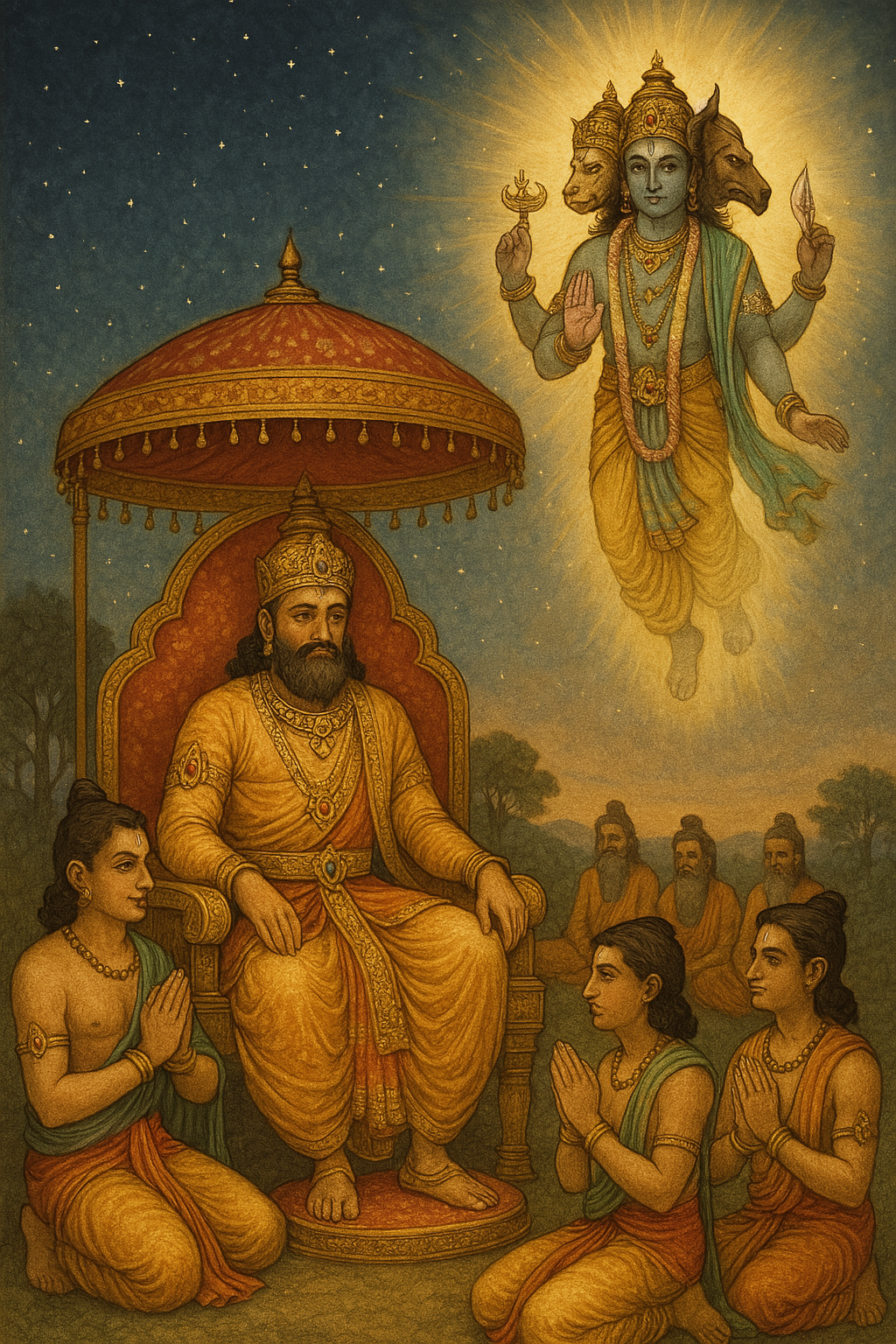
Raivat Manu, the fifth of the legendary Manus and a central figure in early Vedic civilization, is recognized in ancient Indian history as a lawgiver, king, and spiritual guide during the Raivata Manvantara—the fifth great age of mankind. He was the twin brother of Tamasa Manu, and together they represent successive pillars of moral and spiritual evolution in early human society.
Raivata Manu is traditionally understood to have ruled over a peaceful and spiritually advanced civilization. His reign marked a period of cosmic alignment, guided by sacred law, education, and spiritual advancement. His sons, including Arjuna, Bali, and Vindhya, were noble rulers and guardians of dharma who carried forward his legacy in different regions.
During his time, the Bhutarayas were recognized as the ruling demigods—celestial beings who helped maintain cosmic order. The seven sages (Saptarishis) of this epoch were Hiranyaroma, Vedasrí, Urddhabahu, Vedabahu, Sudhaman, Parjanya, and Mahámuni. These sages were revered for their profound spiritual insight and guided human civilization in ethics, governance, and metaphysical understanding.
The Vishnu avatar of this manvantara was Vaikuntha, a divine incarnation born to restore righteousness. Not to be confused with the spiritual realm of the same name, Vaikuntha in this context was a historical avatar of Vishnu, who incarnated specifically during Raivata Manu’s era to oversee the harmony between spiritual and material life. His presence during this epoch affirmed the cosmic cycle of divine intervention in times of great societal change.
Raivat Manu’s life and rule are chronicled in ancient Indian scriptures as a historical memory, preserved through oral traditions, genealogies, and sacred texts. Far from being mythological, his existence reflects the organized social, spiritual, and political structures of early Vedic civilizations.