Unveiling the Cosmic Dawn
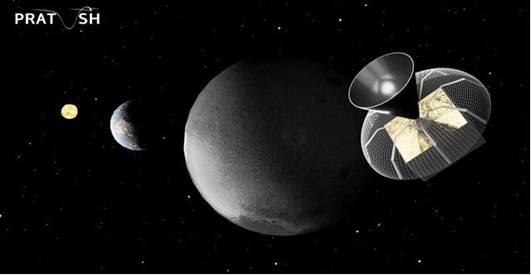
The Cosmic Dawn marks the period when the first stars and galaxies ignited, altering the Universe’s evolution. Yet, direct evidence of this era remains elusive. PRATUSH seeks to detect the elusive 21-cm radio signal emitted by hydrogen atoms, which carries imprints of early cosmic events. On Earth, this signal is masked by radio interference, including FM transmissions and atmospheric distortion, making the lunar far-side the ideal observation point.
 The Power of a Tiny Computer
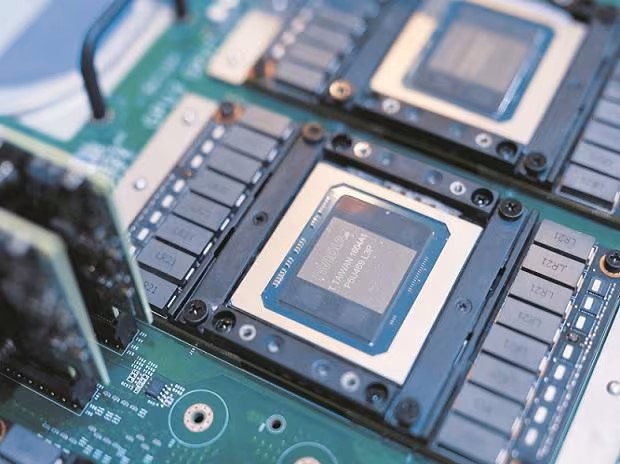
At the heart of PRATUSH is a digital receiver system powered by a single-board computer (SBC) similar to a Raspberry Pi. Despite its small size, the SBC acts as the “master conductor” of the radiometer, coordinating the antenna, analog receiver, and a field-programmable gate array (FPGA) that processes streams of cosmic radio data.
The system records, calibrates, and processes high-speed data streams, ensuring accuracy while consuming minimal power. This low-mass, high-capability design reduces mission weight and cost—crucial factors for space exploration. In future flight models, the commercial SBC may be replaced by a space-grade version.
Performance Breakthroughs
Extensive tests show that PRATUSH’s receiver can reduce noise to just a few millikelvins after 352 hours of reference data collection—sensitive enough to pick out the Cosmic Dawn signal. Software upgrades and next-generation hardware promise even greater reliability, making the system ready for lunar deployment.
“By adopting a single-board computer, PRATUSH achieves a rare balance of efficiency, precision, and adaptability for space science,” said Girish B. S., Research Scientist at RRI. His colleague Srivani K. S. added that the compact system ensures smooth calibration and robust data handling in extreme conditions.
Why the Moon’s Far Side?
The lunar far side is one of the quietest places in the inner Solar System, free from Earth’s radio interference and ionospheric noise. By placing PRATUSH there, India aims to create a pristine window into the early Universe. According to astronomers Saurabh Singh and Mayuri Rao of RRI, this technology could pave the way for future missions exploring cosmic origins and even new physics.
India’s Role in Frontier Science
PRATUSH showcases how Indian scientists are innovating with compact, cost-effective solutions for space science. By leveraging government-backed research, the mission aligns with global efforts to unlock one of astronomy’s greatest mysteries. If successful, PRATUSH could position India as a leader in probing the earliest chapters of the cosmos.
Behind this bold vision lies a humble yet powerful tool—a tiny computer with the potential to decode the story of the first stars.