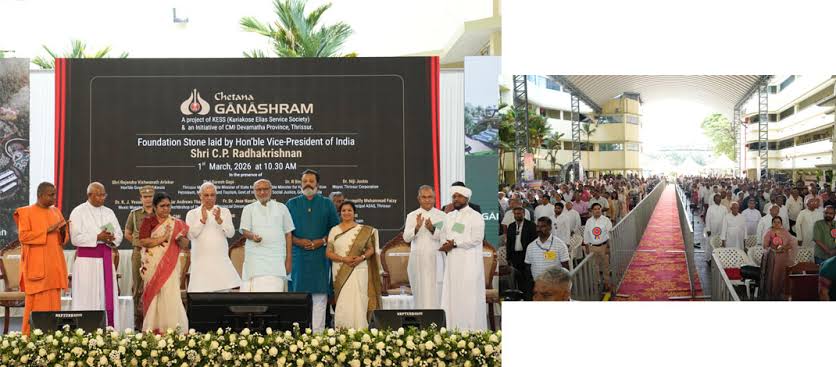
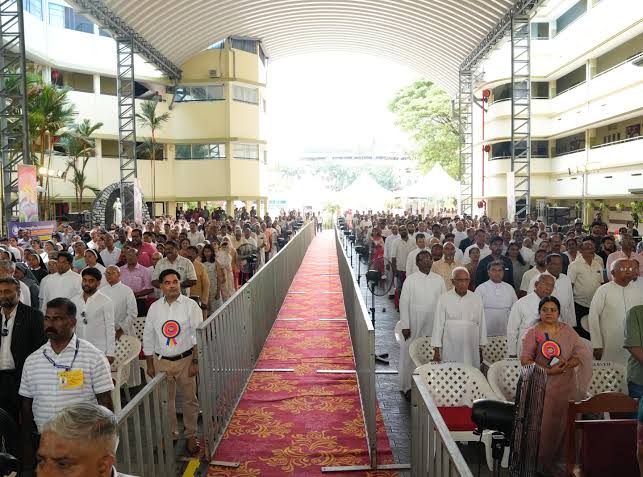
The Vice-President of India, Shri C.P. Radhakrishnan, on Sunday laid the foundation stone of Chetana Ganashram in Thrissur, describing music as Bharat’s spiritual lifeline and a powerful force for healing in modern society. The eco-friendly campus is envisioned as a centre for music meditation, therapy, and interfaith harmony.
 Music as Bharat’s Spiritual Journey
Addressing the gathering, the Vice-President said that Indian music is far more than sound. “The music of Bharat is a spiritual journey, a meditation, a prayer, and a celebration of life,” he said, describing it as the purest expression of the nation’s civilisational soul.
He noted that from the hymns of the Vedas to the devotional songs of saints, music has flowed through India like the holy Ganga, binding millions of hearts in a shared rhythm. According to him, music has always been a thread connecting diverse communities across centuries.
Highlighting South India’s musical heritage, he referred to inscriptions at the Brihadisvara Temple built by the Chola kings, which recorded the patronage of musicians and dancers. Sacred hymns such as Thevaram, he added, were regularly rendered in temples, demonstrating the continuity of India’s devotional traditions.
Hindustani and Carnatic Traditions
The Vice-President described Hindustani and Carnatic classical music as profound sciences of sound. He recalled the immortal compositions of Tyagaraja, the genius of Tansen, the divine voice of M.S. Subbulakshmi, and the global influence of Ravi Shankar.
Indian music, he said, has inspired audiences across continents and continues to serve as a bridge between cultures. He underlined that both Western and Indian music are built upon seven fundamental notes, known in India as Sapta Swaras.
According to him, these seven notes resonate with human emotions, regulate breathing, steady the heartbeat, reduce stress, and enhance concentration. “When a beautiful raga flows at dawn or a devotional hymn fills a sacred space, music becomes medicine,” he observed.
Chetana Ganashram’s Vision
The proposed campus will house five dedicated centres or ‘alayams’: Dhyana-alayam for music meditation, Sangeet-alayam for neurologic music therapy, Sabd-alayam for voice therapy, Kala-alayam for Indian music and dance, and Yoga-alayam for yoga therapy.
Calling the initiative visionary, the Vice-President said the seven notes symbolise unity in diversity — each distinct yet harmonious together. He praised the inclusive management of the Ganashram, which involves members from different faiths and noted personalities including renowned singer K.J. Yesudas.
He expressed confidence that the institution would serve as a healing space, especially in a fast-moving and often stressful world where mental wellness has become a pressing concern.
Yoga and India’s Soft Power
The Vice-President also highlighted the global recognition that Yoga has received under the leadership of Prime Minister Narendra Modi. He said Yoga has emerged as a symbol of India’s soft power and reflects the philosophy of Vasudhaiva Kutumbakam — the world is one family.
He added that the Central Government has created vibrant platforms for the exchange of musical traditions, strengthening unity in diversity and enhancing global appreciation for India’s cultural heritage.
The ceremony was attended by Kerala Governor Rajendra Vishwanath Arlekar, Union Minister of State Suresh Gopi, Kerala Higher Education Minister Dr. R. Bindu, Thrissur Mayor Dr. Niji Justin, Archbishop Mar Andrews Thazath, and other dignitaries.
Concluding his address, the Vice-President wished the project success and expressed hope that the eternal vibrations of Sa, Re, Ga, Ma, Pa, Dha, Ni would continue to heal hearts and guide humanity towards harmony.