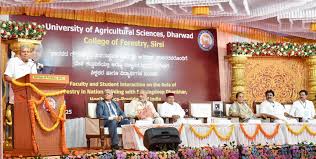
In a deeply moving and energizing address at the College of Forestry in Sirsi, the Vice President of India spoke directly to the hearts of students and faculty, praising their passion and commitment while emphasizing the sacred responsibility of protecting nature. His speech resonated with empathy, pride, and a sense of urgency—echoing the bond between India’s cultural heritage and environmental consciousness.
As he entered the lush green campus nestled in the Western Ghats, the Vice President expressed how the enthusiasm of the students uplifted his own energy. Observing the gender balance in the audience, he applauded the spirit of equality and the vibrant atmosphere of the institution, which he described as a classroom without walls, open and alive, surrounded by nature in its purest form.
He spoke with affection about the unique fragrances of Sirsi’s air—cardamom, pepper, bitter leaves, and vanilla—which not only define India’s culinary identity but have also driven its prosperity for centuries. In his words, the environment here speaks for itself, and every sound from rustling leaves to gurgling streams carries a message for those willing to listen.
Addressing the students as future ambassadors of the environment, he reminded them that they are not just learners but torchbearers of sustainable living. He emphasized that sustainability is not merely an economic goal but a moral and spiritual necessity rooted deeply in India’s Vedic traditions. The Vice President urged everyone to recognize that natural resources are not commodities for greed but sacred assets meant to meet basic needs and be preserved for future generations.
He reflected on the spiritual essence of the land, where sustainability and spirituality merge, and cautioned against the reckless exploitation of the environment. “We are trustees of nature, not mere consumers,” he reminded, urging a conscious and restrained approach to resource use. Highlighting the pressing threat of climate change, he called it an existential challenge that must be faced collectively, reminding the audience that Earth is the only home we have, and it belongs not just to humans but to all living beings.
The Vice President was visibly touched by the contributions of the college’s alumni, who are making notable impacts across public and private sectors. He encouraged the formation of a strong alumni network to support institutional growth and policy evolution, recognizing the invaluable human resource they represent.
With warmth and conviction, he called the students “foot soldiers of Bharat Mata” and acknowledged the global attention India now receives due to its youth power. Reflecting on India’s exponential progress in recent years, he reassured students of abundant opportunities ahead and encouraged them to remain curious, inquisitive, and rooted in values. He reminded them that their field of study—forestry—holds the key to both healing and nourishing the planet.
In a heartfelt gesture, he planted a tree in memory of his mother, tying it to the national initiative “Ek Ped Maa Ke Naam,” and urged everyone to do the same. This symbolic act reinforced the message that environmental conservation is a personal, emotional, and national duty.
As he concluded, the Vice President praised the students for choosing a path that is not just academically valuable but essential for humanity’s survival. His words were not only an inspiration but a sincere call to action—for every student to embrace their role as guardians of nature, and to serve society and the Earth with dedication and pride.